
June 2022 Paper 1 Q8
8 The lines \(L_1\) and \(L_2\) are parallel.
\(L_1\) has equation
\[5x + 3y = 15\]and \(L_2\) has equation
\[5x + 3y = 83\]\(L_1\) intersects the \(y\)-axis at the point \(P\).
The point \(Q\) is the point on \(L_2\) closest to \(P\), as shown in the diagram.
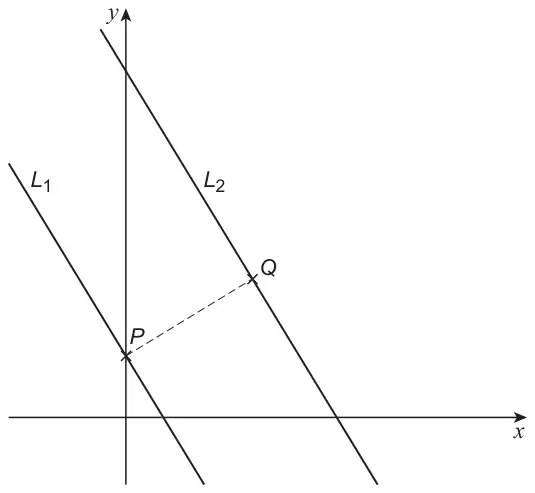
(a)
(i) Find the coordinates of \(Q\). [5 marks]
(ii) Hence show that \(PQ = k\sqrt{34}\), where \(k\) is an integer to be found. [2 marks]
(b) A circle, \(C\), has centre \((a, -17)\).
\(L_1\) and \(L_2\) are both tangents to \(C\).
(i) Find \(a\). [2 marks]
(ii) Find the equation of \(C\). [2 marks]
| Scheme | Marks | AO |
|---|---|---|
| (i) Obtains correct \(y\)-intercept at \(P\) (0,5) or \(y\) = 5 seen anywhere PI by correct equation for line \(PQ\) | B1 | 3.1a |
| Obtains equation of \(PQ\) with correct gradient. For example \(y = \dfrac{3}{5}x + c\) or \(5y - 3x = k\) or Forms an equation for the distance or distance squared from (0,5) to a point on \(L_2\) For example, \(d^2 = x^2 + \left(-\dfrac{5}{3}x + \dfrac{68}{3}\right)^2\) | M1 | 3.1a |
| Obtains correct equation ACF | A1 | 1.1b |
| Solves simultaneous equations for their \(PQ\) and \(L_2\) to obtain values for \(x\) and \(y\) Their \(PQ\) must not be a horizontal or vertical line Condone errors in rearrangement of the equation(s) or Minimises their distance or distance squared equation to find one coordinate | M1 | 3.1a |
| Obtains (10, 11) or \(x = 10,\ y = 11\) | A1 | 1.1b |
| (5) | ||
| (ii) Uses the distance formula to find the value of \(PQ\) or \(PQ^2\) or Uses Pythagoras theorem with \(10^2 + 6^2\) seen If the coordinates of \(P\) and \(Q\) are incorrect, differences in \(x\) and \(y\) must be clearly shown for M1 | M1 | 1.1a |
| Completes demonstration to show that \(k\) = 2 Must have shown clear use of distance formula Condone not seeing \(x\) = 0 substituted in the distance formula Answer of \(2\sqrt{34}\) and no working shown scores M1 R0 | R1 | 2.1 |
| (2) |
Typical solution
(i)
At \(P\)
\[x = 0 \Rightarrow y = 5\]Line \(PQ\)
\[3x - 5y = -25\]\[5x + 3y = 83\](10, 11)
(ii)
\[PQ^2 = (10 - 0)^2 + (11 - 5)^2\]\[PQ = \sqrt{136} = 2\sqrt{34}\]| Scheme | Marks | AO |
|---|---|---|
| (i) Uses a valid method to find \(a\). Evidence could be: Forming the equation of the line mid-way between \(L_1\) and \(L_2\) \(5x + 3y = 49\) seen or Using \((a, -17)\) as the mid-point of a line segment from \(L_1\) to \(L_2\) For example: \(5x + 3(-17) = 15 \quad x = 13.2\) \(5x + 3(-17) = 83 \quad x = 26.8\) \(a = \dfrac{(26.8 + 13.2)}{2} = 20\) or Finding the mid-point of \(PQ\) their (5 , 8) and using the gradient of \(L_1\) and \(L_2 = -\dfrac{5}{3}\) For example: \(8 + 5(-5) = -17\) \(a = 5 + 5(3) = 20\) or Substitutes \(y\) = 17 and \(x = a\) into \(y = \dfrac{3}{5}x + 5\) | M1 | 3.1a |
| Deduces \(a\) = 20 | R1 | 2.2a |
| (2) | ||
| (ii) Forms expression of the form \((x \pm a)^2 + (y \pm 17)^2\) using \(a\) or their value of \(a\) | M1 | 1.1a |
| Obtains correct equation for their value of \(a\) and their radius2 = \(\dfrac{17k^2}{2}\) from part (a)(ii) for an integer value of \(k\) Condone \(\left(\sqrt{34}\right)^2\) | A1F | 1.1b |
| (2) | ||
| (11 marks) |
Typical solution
(i)
\[5x + 3y = 49\]\[5a + 3(-17) = 49\]\[a = 20\](ii)
\[(x - 20)^2 + (y + 17)^2 = 34\]