(a) Given that\[\frac{1}{16 - 9x^2} \equiv \frac{A}{4 - 3x} + \frac{B}{4 + 3x}\]find the values of \(A\) and \(B\) [3 marks]
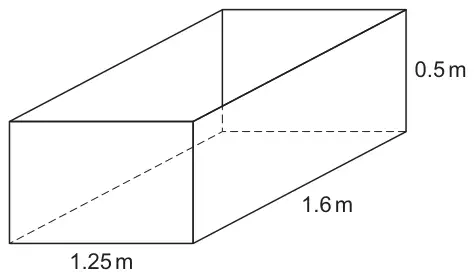
(b) An empty container, in the shape of a cuboid, has length 1.6 metres, width 1.25 metres and depth 0.5 metres, as shown in the diagram below.
The container has a small hole in the bottom.
Water is poured into the container at a rate of 0.16 cubic metres per minute.
At time \(t\) minutes after the container starts to be filled, the depth of water is \(d\) metres and water leaks out at a rate of \(0.36d^2\) cubic metres per minute.
At time \(t\) minutes after the container starts to be filled, the volume of water in the container is \(V\) cubic metres.
(i) Show that\[\frac{\mathrm{d}V}{\mathrm{d}t} = \frac{16 - 9V^2}{100}\] [4 marks]
(ii) Hence, find \(t\) in terms of \(V\) [5 marks]
(iii) Determine how long it takes to fill the container with water.
Give your answer to the nearest minute. [2 marks]
Mark scheme (a)
Scheme
Marks
AO
Uses a suitable method and finds a value for \(A\) or \(B\). For example Rearranges and substitutes values or compares coefficients Or Uses cover-up method Or Uses inspection PI by \(A\) correct or \(B\) correct.
M1
1.1a
Obtains \(A = \dfrac{1}{8}\)
A1
1.1b
Obtains \(B = \dfrac{1}{8}\)
A1
1.1b
(3)
Typical solution
\[\frac{1}{(4 - 3x)(4 + 3x)} \equiv \frac{A}{4 - 3x} + \frac{B}{4 + 3x}\]\[1 \equiv A(4 + 3x) + B(4 - 3x)\]\[\text{Let } x = -\frac{4}{3}\]\[1 \equiv 8B \Rightarrow B = \frac{1}{8}\]\[\text{comparing } x \text{ terms } A = B = \frac{1}{8}\]
Mark scheme (b)
Scheme
Marks
AO
(i) Forms differential equation using \(\dfrac{\mathrm{d}V}{\mathrm{d}t} = \pm 0.16 \pm 0.36d^2\)
M1
3.3
Obtains \(V = 1.25 \times 1.6d\) OE
B1
3.1b
Substitutes their expression for d into \(\dfrac{\mathrm{d}V}{\mathrm{d}t} = \pm 0.16 \pm 0.36d^2\) to obtain a differential equation in \(V\) and \(t\) only.
M1
3.1a
Completes reasoned argument to show the given result. AG
R1
2.1
(4)
(ii) Rearranges to obtain one of the following:\[\begin{gathered} \frac{P}{16 - 9V^2}\,\mathrm{d}V = \frac{1}{Q}\,\mathrm{d}t \\ \frac{P}{16 - 9V^2}\frac{\mathrm{d}V}{\mathrm{d}t} = \frac{1}{Q} \\ \frac{P}{16 - 9V^2} = \frac{1}{Q}\frac{\mathrm{d}t}{\mathrm{d}V} \end{gathered}\]where \(P \times Q = 100\) If their P = 100 no need to see \(\dfrac{1}{Q}\) explicit with d\(t\)
May include integral signs PI \(\displaystyle\int \frac{100}{16 - 9V^2}\,\mathrm{d}V = t\)
B1
3.1a
Integrates their constant integrand correctly with respect to \(t\). Follow through any constant.
B1F
1.1b
Writes \(\displaystyle\int \frac{1}{16 - 9V^2}\,\mathrm{d}V\) as \(\displaystyle\int \frac{A}{4 - 3V} + \frac{B}{4 + 3V}\,\mathrm{d}V\) Condone missing \(\mathrm{d}V\) PI by \(-\dfrac{A}{3}\ln(4 - 3V) + \dfrac{B}{3}\ln(4 + 3V)\)
M1
3.1a
Integrates their partial fractions correctly to obtain \(-\dfrac{A}{3}\ln(4 - 3V) + \dfrac{B}{3}\ln(4 + 3V) \quad (+c)\) OE Their \(A\) and \(B\) may be correctly inside the natural logs for example \(\dfrac{1}{24}\left(-\ln(32 - 24V) + \ln(32 + 24V)\right)\)
A1F
1.1b
Completes argument, including demonstrating that the constant of integration is zero.
R1
2.1
(5)
(iii) Obtains a value for \(t\) by substituting \(V = 1\) into their expression for \(t\) from their final answer from b(ii) PI by 8 minutes from a correct answer from b(ii)
M1
3.4
Obtains 8 minutes following a correct answer in b(ii) Condone missing units