
June 2023 Paper 1 Q15
15 The curve with equation
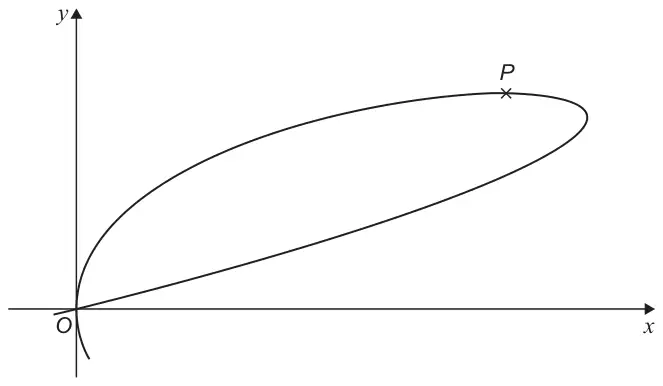
\[x^2 + 2y^3 - 4xy = 0\]has a single stationary point at \(P\) as shown in the diagram below.
(a) Show that the \(y\)-coordinate of \(P\) satisfies the equation\[y^2(y - 2) = 0\] [7 marks]
(b) Hence, find the coordinates of \(P\) [2 marks]
| Scheme | Marks | AO |
|---|---|---|
| Differentiates \(x^2\) to obtain \(2x\) | B1 | 1.1b |
| Uses implicit differentiation and obtains either \(Ay^2\dfrac{\mathrm{d}y}{\mathrm{d}x}\) or \(Bx\dfrac{\mathrm{d}y}{\mathrm{d}x}\) terms | M1 | 3.1a |
| Uses product rule to obtain \(\pm 4y \pm 4x\dfrac{\mathrm{d}y}{\mathrm{d}x}\) condone sign errors | M1 | 1.1a |
| Obtains \(2x + 6y^2\dfrac{\mathrm{d}y}{\mathrm{d}x} - 4y - 4x\dfrac{\mathrm{d}y}{\mathrm{d}x} = 0\) OE | A1 | 1.1b |
| Substitutes \(\dfrac{\mathrm{d}y}{\mathrm{d}x} = 0\) into their differentiated expression which contains either \(Ay^2\dfrac{\mathrm{d}y}{\mathrm{d}x}\) or \(Bx\dfrac{\mathrm{d}y}{\mathrm{d}x}\) PI by later work. | M1 | 1.1a |
| Deduces \(x = 2y\) or \(2x = 4y\) or \(-x = -2y\) or \(-2x = -4y\) Must have scored A1 with no incorrect rearrangement of \(2x + 6y^2\dfrac{\mathrm{d}y}{\mathrm{d}x} - 4y - 4x\dfrac{\mathrm{d}y}{\mathrm{d}x} = 0\) used. | R1 | 2.2a |
| Eliminates \(x\) in given equation and completes reasoned argument with at least one intermediate step to show the given result. Must have scored first 6 marks with no incorrect rearrangement of \(2x + 6y^2\dfrac{\mathrm{d}y}{\mathrm{d}x} - 4y - 4x\dfrac{\mathrm{d}y}{\mathrm{d}x} = 0\) used. | R1 | 2.1 |
| (7) |
Typical solution
\[x^2 + 2y^3 - 4xy = 0\]\[2x + 6y^2\frac{\mathrm{d}y}{\mathrm{d}x} - 4y - 4x\frac{\mathrm{d}y}{\mathrm{d}x} = 0\]At stationary point \(\dfrac{\mathrm{d}y}{\mathrm{d}x} = 0\)
So
\[2x - 4y = 0\]\[x = 2y\]\[(2y)^2 + 2y^3 - 4(2y)y = 0\]\[4y^2 + 2y^3 - 8y^2 = 0\]\[2y^3 - 4y^2 = 0\]\[y^2(y - 2) = 0\]| Scheme | Marks | AO |
|---|---|---|
| Obtains \(y\)-coordinate of 2 Accept \(y = 2\) | B1 | 1.1b |
| Obtains \(x\)-coordinate of 4 Accept \(x = 4\) | B1 | 1.1b |
| (2) | ||
| (9 marks) |
Typical solution
(4, 2)