
June 2019 Paper 3 Mechanics Q5
5.
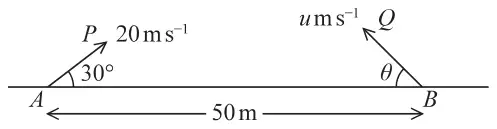
The points \(A\) and \(B\) lie 50 m apart on horizontal ground.
At time \(t = 0\) two small balls, \(P\) and \(Q\), are projected in the vertical plane containing \(AB\).
Ball \(P\) is projected from \(A\) with speed \(20\ \text{m s}^{-1}\) at \(30^\circ\) to \(AB\).
Ball \(Q\) is projected from \(B\) with speed \(u\ \text{m s}^{-1}\) at angle \(\theta\) to \(BA\), as shown in Figure 3.
At time \(t = 2\) seconds, \(P\) and \(Q\) collide.
Until they collide, the balls are modelled as particles moving freely under gravity.
| Scheme | Marks | AO |
|---|---|---|
| Horizontal speed \(= 20\cos 30^\circ\) | B1 | 3.4 |
| Vertical velocity at \(t = 2\) | M1 | 3.4 |
| \(= 20\sin 30^\circ - 2g\) | A1 | 1.1b |
| \(\theta = \tan^{-1}\left(\pm\dfrac{9.6}{10\sqrt{3}}\right)\) | M1 | 1.1b |
| Speed \(= \sqrt{100 \times 3 + 9.6^2}\) or e.g. speed \(= \dfrac{9.6}{\sin\theta}\) | M1 | 1.1b |
| 19.8 or 20 \((\text{m s}^{-1})\) at \(29.0^\circ\) or \(29^\circ\) to the horizontal oe | A1 | 2.2a |
| (6) |
Notes
In this question mark parts (a) and (b) together.
B1: Seen or implied, possibly on a diagram
M1: Use of \(v = u + at\) or any other complete method using \(t = 2\)
Condone sign errors and sin/cos confusion.
A1: Correct unsimplified equation in \(v\) or \(v^2\)
M1: Correct use of trig to find a relevant angle for the direction.
Must have found a horizontal and a vertical velocity component
M1: Use Pythagoras or trig to find the magnitude
Must have found a horizontal and a vertical velocity component
A1: Or equivalent. Need magnitude and direction stated or implied in a diagram.
(0.506 or 0.51 rads)
| Scheme | Marks | AO |
|---|---|---|
| Using sum of horizontal distances \(= 50\) at \(t = 2\) | M1 | 3.3 |
| \((u\cos\theta) \times 2 + (20\cos 30^\circ) \times 2 = 50\) \((u\cos\theta = 25 - 20\cos 30^\circ)\) | A1 | 1.1b |
| Vertical distances equal | M1 | 3.4 |
| \(\Rightarrow (20\sin 30^\circ) \times 2 - \dfrac{g}{2} \times 4 = (u\sin\theta) \times 2 - \dfrac{g}{2} \times 4\) \((20\sin 30^\circ = u\sin\theta)\) | A1 | 1.1b |
| Solving for both \(\theta\) and \(u\) | M1 | 3.1b |
| \(\theta = 52^\circ\) or better \((52.47756849....^\circ)\) \(u = 13\) or better (12.6085128…) | A1 | 2.2a |
| (6) |
Notes
In this question mark parts (a) and (b) together.
M1: First equation, in terms of \(u\) and \(\theta\) (could be implied by subsequent working), using the horizontal motion with \(t = 2\) used
Condone sign errors and sin/cos confusion
A1: Correct unsimplified equation – any equivalent form
M1: Second equation, in terms of \(u\) and \(\theta\) (could be implied by subsequent working), using the vertical motion – equating distances or just vertical components of velocities.
Condone sign errors and sin/cos confusion
A1: Correct unsimplified equation – any equivalent form
M1: Complete strategy: all necessary equations formed and solve for \(u\) and \(\theta\)
N.B. This is an independent method mark but can only be earned if 50 m has been used in their solution.
A1: Both values correct. (Here we accept 2SF or better, since the \(g\)’s cancel)
Allow radians for \(\theta\): 0.92 or better (0.915906..) rads.
| Scheme | Marks | AO |
|---|---|---|
| It does not take account of the fact that they are not particles (moving freely under gravity) It does not take account of the size(s) of the balls It does not take account of the spin of the balls It does not take account of the wind \(g\) is not exactly \(9.8\ \text{m s}^{-2}\) N.B. If they refer to the mass or weight of the balls give B0 | B1 | 3.5b |
| (1) | ||
| (13 marks) |
Notes
B1: Any factor related to the model as stated in the question.
Penalise incorrect extras but ignore consequences
e.g. ‘\(AB\) (or the ground) is not horizontal’ should be penalised
or ‘they do not move in a vertical plane’ should be penalised