\[\begin{aligned}&\mathrm{f}(x) = x^2 + 5 &&\qquad x \in \mathbb{R}\\ &\mathrm{g}(x) = \sqrt{x} &&\qquad x \geqslant 0\end{aligned}\]
(a) Using set notation, state the range of f [2 marks]
(b) Determine whether f has an inverse.
Fully justify your answer.
[2 marks]
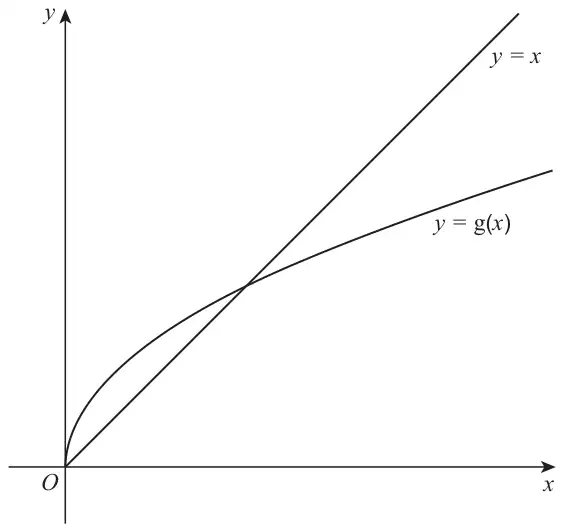
(c) The graph of \(y = \mathrm{g}(x)\), and the line with equation \(y = x\), are shown on the diagram below.
Sketch the graph of \(y = \mathrm{g}^{-1}(x)\) on the diagram.
[2 marks]
(d) The composite function gf is denoted by h
(i) Write down an expression for \(\mathrm{h}(x)\) [1 mark]
(ii) State the range of h [1 mark]
Mark scheme (a)
Scheme
Marks
AO
Deduces \(\geqslant 5\) or \(\gt 5\)
M1
2.2a
Writes the correct range using correct set notation Acceptable examples include: \(\{x : x \geqslant 5\}\) \(\{\mathrm{f}(x) : \mathrm{f}(x) \geqslant 5\}\) \([5, \infty)\) Ignore anything before \([5, \infty)\)
A1
2.5
(2)
Typical solution
Range \(\{y : y \geqslant 5\}\)
Mark scheme (b)
Scheme
Marks
AO
Demonstrates that f is many to one. This could be evidenced by a sketch of the graph of \(y = \mathrm{f}(x)\) demonstrating the horizontal line test, or by giving two \(x\)-values which result in the same value of \(\mathrm{f}(x)\), or states \(\mathrm{f}(-x) = \mathrm{f}(x)\)
E1
2.4
Explains that f is many to one or that f is not one to one and deduces that f does not have an inverse
E1
2.2a
(2)
Typical solution
\(\mathrm{f}(-1) = 6 = \mathrm{f}(1)\)
\(\therefore\) f is many to one, so it does not have an inverse
Mark scheme (c)
Scheme
Marks
AO
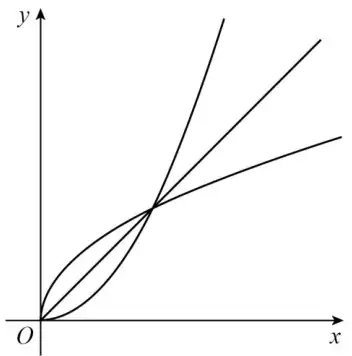
Draws a convex curve between the origin and (1,1) There should be no doubt that their graph intersects (1,1) Ignore anything outside of quadrant 1
M1
1.1a
Sketches a fully correct graph of \(y = x^2\) for \(x \geqslant 0\) Their curve must be in quadrant 1 only.
A1
1.1b
(2)
Typical solution
Mark scheme (d)
Scheme
Marks
AO
(i) Obtains \(\sqrt{x^2 + 5}\) No ISW
B1
1.1b
(1)
(ii) Deduces the range of h Accept \(y \geqslant \sqrt{5}\), \(\mathrm{gf}(x) \geqslant \sqrt{5}\) Condone \(\mathrm{h} \geqslant \sqrt{5}\), \(\mathrm{gf} \geqslant \sqrt{5}\) Or accept set notation in ACF
We'd like to use Google Analytics cookies to count visits and see which pages help most. They're optional, and the site works exactly the same either way. Privacy policy