
June 2024 Paper 3 Q12
12 A particle \(P\) moves in a straight line. The velocity \(v\,\mathrm{m\,s^{-1}}\) of \(P\) at time \(t\) seconds is given by
\(v = \frac{1}{12}kt(t - 3)\) for \(0 \leqslant t \leqslant 6\),
\(v = \dfrac{54k}{t^2}\) for \(6 \leqslant t \leqslant 9\),
where \(k\) is a positive constant.
You are given that the total distance travelled by \(P\) in the interval \(0 \leqslant t \leqslant 9\) is 84 m.
Find the value of \(k\). [6]
| Scheme | Marks | AO |
|---|---|---|
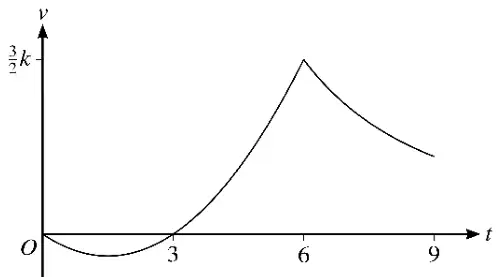 | B1 | 1.1 |
| Inverse proportional (to \(t^2\)) curve (so correct curvature), should not touch the horizontal axis | B1 | 1.1 |
| Completely correct graph with both curves meeting at 6 with values of 3 and 6 on \(t\) axis | B1 | 1.1 |
| [3] |
Notes
No scaling on axes required for the first two B marks (so ignore any scaling for the first two marks)
B1: Quadratic curve (positive quadratic) passing through the origin and appearing in both quadrants with a minimum turning point in the fourth quadrant
B1: Inverse proportional (to \(t^2\)) curve (so correct curvature), should not touch the horizontal axis
Condone if it appears to be approaching a horizontal asymptote (other than the \(t\)-axis) for this mark but gradient must not be positive
B1: Completely correct graph with both curves meeting at 6 with values of 3 and 6 on \(t\) axis (or clearly stated in their working in part (a) only) – this mark is dependent on the previous 2 B marks
Allow only the \(t\)-axis as a horizontal asymptote
Value of 9 not required on \(t\) axis, neither is \(\frac{3}{2}k\) on the \(v\)-axis
| Scheme | Marks | AO |
|---|---|---|
| 1.5 (s) only | B1 | 1.1 |
| [1] |
Notes
B1: From symmetry or solving \(\frac{1}{12}k(2t - 3) = 0\) www
Any other answer(s) is B0
| Scheme | Marks | AO |
|---|---|---|
| DR \(\displaystyle [k]\tfrac{1}{12}\int \left(t^2 - 3t\right)\mathrm{d}t = \frac{1}{12}\left(\frac{t^3}{3} - \frac{3}{2}t^2\right)[k]\) | M1* | 2.1 |
| For both \(\displaystyle [k]\tfrac{1}{12}\int_0^3 \left(t^2 - 3t\right)\mathrm{d}t = -\frac{3}{8}[k]\) or \(+\frac{3}{8}[k]\) and \(\displaystyle [k]\tfrac{1}{12}\int_3^6 \left(t^2 - 3t\right)\mathrm{d}t = \frac{15}{8}[k]\) (but allow correct un-simplified expressions – SEE APPENDIX) | B1 | 1.1 |
| \(\displaystyle [k]\int \frac{54}{t^2}\,\mathrm{d}t = -\frac{54}{t}[k]\) | M1* | 1.1 |
| \(\displaystyle [k]\int_6^9 \frac{54}{t^2}\,\mathrm{d}t = 3[k]\) (allow correct un-simplified – SEE APPENDIX) | B1 | 1.1 |
| \(\frac{3}{8}k + \frac{15}{8}k + 3k = 84\) or \(\frac{18}{8}k + 3k = 84\) | M1dep* | 3.4 |
| \(k = 16\) | B1 | 2.2a |
| [6] |
Notes
M1*: Attempt to integrate – both terms with power increased by 1 with one term correct
Ignore \(+c\) omission for M marks
B1: www
Condone \(\displaystyle [k]\tfrac{1}{12}\int_0^3 \left(t^2 - 3t\right)\mathrm{d}t = +\frac{3}{8}[k]\)
Award B1 for \(\displaystyle [k]\tfrac{1}{12}\int_0^6 \left(t^2 - 3t\right)\mathrm{d}t = \frac{18}{8}[k]\) but B0 for \(\displaystyle [k]\tfrac{1}{12}\int_0^6 \left(t^2 - 3t\right)\mathrm{d}t = \frac{12}{8}[k]\)
The correct values do not imply the M mark as DR
M1*: Attempt to integrate – answer of the form \(ct^{-1}\) with \(c \ne 1, 54k, 54\)
B1: www
The correct value does not imply the M mark as DR
M1dep*: Forming a linear equation in \(k\) with the correct number of relevant terms (e.g. must have taken the modulus of their integral from 0 to 3)
\(\displaystyle \tfrac{1}{12}k\int_0^6 \left(t^2 - 3t\right)\mathrm{d}t = \frac{12}{8}k\), or any working that suggests the modulus was not taken between 0 and 3 is M0
B1: www
Additional guidance for 12(c) (Appendix)
The square brackets around the \(k\) in the main scheme means that this may be omitted as they could deal with this constant at the end when they form their equation with the 84 (as the \(k\) is a constant factor for both expressions for \(v\))
The first B mark is for a correct expression/value for both \(\displaystyle I_1 = [k]\tfrac{1}{12}\int_0^3 \left(t^2 - 3t\right)\mathrm{d}t\) and \(\displaystyle I_2 = [k]\tfrac{1}{12}\int_3^6 \left(t^2 - 3t\right)\mathrm{d}t\) in any un-simplified form:
so for \(I_1\) any expression that is equivalent to \(\pm\frac{1}{12}\left(\frac{3^3}{3} - \frac{3(3)^2}{2}\right)[k]\) is fine (allow either positive or negative due to the fact that this area is below the \(t\)-axis) e.g. \(I_1 = \pm\frac{1}{12}\left(9 - \frac{27}{2}\right)[k]\) or \(\pm\frac{9}{24}[k]\) etc. (ISW once a correct un-simplified form is seen)
For \(I_2\) any expression that is equivalent to \(\frac{1}{12}\left(\frac{6^3}{3} - \frac{3(6)^2}{2}\right)[k] - \frac{1}{12}\left(\frac{3^3}{3} - \frac{3(3)^2}{2}\right)[k]\) is fine e.g. \(\frac{1}{12}(72 - 54)[k] - \frac{1}{12}\left(9 - \frac{27}{2}\right)[k]\) or \(\left(\frac{3}{2} + \frac{3}{8}\right)[k]\) etc.
If the candidate does not consider these two integrals separately and instead attempts to combine as a single integral (between 0 and 6) then they must consider it correctly (given the applied context) so e.g.
\(\displaystyle I_{1,2} = [k]\tfrac{1}{12}\int_0^6 \left(t^2 - 3t\right)\mathrm{d}t = -\tfrac{1}{12}\left(\tfrac{3^3}{3} - \tfrac{3(3)^2}{2}\right)[k] + \tfrac{1}{12}\left(\tfrac{6^3}{3} - \tfrac{3(6)^2}{2}\right)[k] - \tfrac{1}{12}\left(\tfrac{3^3}{3} - \tfrac{3(3)^2}{2}\right)[k]\) scores B1 but \(+\tfrac{1}{12}\left(\tfrac{3^3}{3} - \tfrac{3(3)^2}{2}\right)[k] + \tfrac{1}{12}\left(\tfrac{6^3}{3} - \tfrac{3(6)^2}{2}\right)[k] - \tfrac{1}{12}\left(\tfrac{3^3}{3} - \tfrac{3(3)^2}{2}\right)[k]\) is B0
The second B mark is for a correct expression/value for \(\displaystyle I_3 = 54[k]\int_6^9 t^{-2}\,\mathrm{d}t\) in any un-simplified form: e.g. \(I_3 = 54\left(-\frac{1}{9} - \left(-\frac{1}{6}\right)\right)[k]\) or \(54\left(-\frac{1}{9} + \frac{1}{6}\right)[k]\) etc. (ISW once a correct un-simplified form is seen)
The third M mark is for considering \(|I_1| + I_2 + I_3 = 84\) to form a linear equation in \(k\) (with the correct number of relevant terms) – this mark is dependent on the first two M marks and also they must have taken the modulus or equivalent for their integral between 0 and 3 for this mark e.g. they must have considered \(\displaystyle -[k]\tfrac{1}{12}\int_0^3 \left(t^2 - 3t\right)\mathrm{d}t\) or \(\displaystyle [k]\tfrac{1}{12}\int_3^0 \left(t^2 - 3t\right)\mathrm{d}t\) oe
As this question is detailed reasoning the stages as shown in the MS must all be done to award each corresponding mark. So, an answer of \(k = 16\) with no working scores B1 only.