
June 2025 Paper 1 Q11
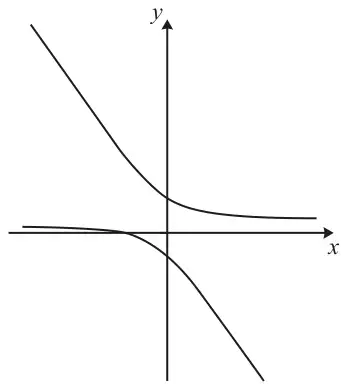
11 The curve in the graph below is defined implicitly by \((2x + y)(y - 1) = 6\).
| Scheme | Marks | AO |
|---|---|---|
| \(\left(2 + \dfrac{\mathrm{d}y}{\mathrm{d}x}\right)(y-1) + (2x+y)\dfrac{\mathrm{d}y}{\mathrm{d}x} = 0\) | M1 M1 | 1.1 1.1 |
| \((2y + 2x - 1)\dfrac{\mathrm{d}y}{\mathrm{d}x} + 2y - 2 = 0\) | M1 | 2.1 |
| \(\dfrac{\mathrm{d}y}{\mathrm{d}x} = \dfrac{2(1-y)}{2y + 2x - 1}\) | A1 | 2.1 |
| [4] |
Notes
M1: Attempt to differentiate both sides of the equation RHS = 0 soi
May see multiplied out (either before or after differentiation)
M1: Attempt to use the product rule for LHS
Not dependent on first M1
Or attempt to differentiate a term in \(xy\) from their multiplied-out LHS.
M1: Collects terms. Independent of previous M marks
A1: Convincing argument including RHS=0 seen above
AG
| Scheme | Marks | AO |
|---|---|---|
| At (2, 2), \(\dfrac{\mathrm{d}y}{\mathrm{d}x} = -\dfrac{2}{7}\) | B1 | 1.1 |
| Gradient of normal is \(\dfrac{7}{2}\) | B1FT | 1.1 |
| So equation of the normal is \(y - 2 = \dfrac{7}{2}(x - 2)\) | B1 | 1.1 |
| [3] |
Notes
B1: soi
B1FT: FT their value for \(\frac{\mathrm{d}y}{\mathrm{d}x}\)
Soi Allow \(-\dfrac{2y + 2x - 1}{2(1-y)}\)
B1: Any form eg \(y = 3.5x - 5\)
| Scheme | Marks | AO |
|---|---|---|
| If the tangent is parallel to the axis \(\dfrac{\mathrm{d}y}{\mathrm{d}x} = \dfrac{2(1-y)}{2y + 2x - 1} = 0\) | M1 | 3.1a |
| So \(y = 1\) | B1 | 1.1 |
| When \(y = 1,\ (y-1) = 0\) \((2x+y)0 = 6\) which is not possible | A1 | 2.1 |
| [3] |
Notes
M1: Equates \(\frac{\mathrm{d}y}{\mathrm{d}x} = 0\) and attempts to solve .
Award if \(2 - 2y = 0\) seen
B1: Award if seen
A1: Clear evidence this is not possible
Eg \(0 \neq 6\) seen