
C2 June 2016 Q7
7.
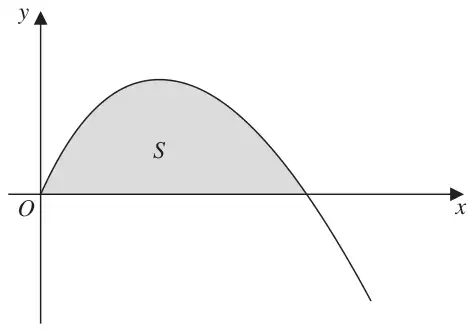
Figure 3 shows a sketch of part of the curve with equation\[y = 3x - x^{\frac{3}{2}}, \qquad x \geqslant 0\]
The finite region \(S\), bounded by the \(x\)-axis and the curve, is shown shaded in Figure 3.
| Scheme | Marks |
|---|---|
| \(\left\{\displaystyle\int \left(3x - x^{\frac{3}{2}}\right)\mathrm{d}x\right\} = \dfrac{3x^2}{2} - \dfrac{x^{\frac{5}{2}}}{\left(\frac{5}{2}\right)}\ \{+c\}\) | M1 A1 A1 |
| (3) |
Notes
M1 Either \(3x \to \pm\lambda x^2\) or \(x^{\frac{3}{2}} \to \pm\mu x^{\frac{5}{2}}\), \(\lambda, \mu \neq 0\)
1st A1 At least one term correctly integrated. Can be simplified or un-simplified but power must be simplified. Then isw.
2nd A1 Both terms correctly integrated. Can be un-simplified (as in the scheme) but the \(n\)+1 in each denominator and power should be a single number. (e.g. 2 – not 1+1) Ignore subsequent work if there are errors simplifying. Ignore the omission of “\(+ c\)”. Ignore integral signs in their answer.
| Scheme | Marks |
|---|---|
| \(0 = 3x - x^{\frac{3}{2}} \Rightarrow 0 = 3 - x^{\frac{1}{2}}\) or \(0 = x\left(3 - x^{\frac{1}{2}}\right) \Rightarrow x = \ldots\) Sets \(y = 0\), in order to find the correct \(x^{\frac{1}{2}} = 3\) or \(x = 9\) | M1 |
| \(\left\{\text{Area}(S) = \left[\dfrac{3x^2}{2} - \dfrac{2}{5}x^{\frac{5}{2}}\right]_0^9\right\}\) | |
| \(= \left(\dfrac{3(9)^2}{2} - \left(\dfrac{2}{5}\right)(9)^{\frac{5}{2}}\right) - \{0\}\) Applies the limit 9 on an integrated function with no wrong lower limit. | ddM1 |
| \(\left\{= \left(\dfrac{243}{2} - \dfrac{486}{5}\right) - \{0\}\right\} = \dfrac{243}{10}\) or 24.3 | A1 oe |
| (3) | |
| 6 |
Notes
1st M1 Sets \(y = 0\), and reaches the correct \(x^{\frac{1}{2}} = 3\) or \(x = 9\) (isw if \(x^{\frac{1}{2}} = 3\) is followed by \(x = \sqrt{3}\))
Just seeing \(x = \sqrt{3}\) without the correct \(x^{\frac{1}{2}} = 3\) gains M0. May just see \(x = 9\).
Use of trapezium rule to find area is M0A0 as hence implies integration needed.
ddM1 This mark is dependent on the two previous method marks and needs both to have been awarded. Sees the limit 9 substituted in an integrated function. (Do not follow through their value of \(x\)) Do not need to see MINUS 0 but if another value is used as lower limit – this is M0.
This mark may be implied by 9 in the limit and a correct answer.
A1 \(\dfrac{243}{10}\) or 24.3
Common Error \(0 = 3x - x^{\frac{3}{2}} \Rightarrow x^{\frac{1}{2}} = 3\) so \(x = \sqrt{3}\)
Then uses limit \(\sqrt{3}\) etc gains M1 M0 A0 so 1/3