
C2 June 2014 (R) Q6
6.
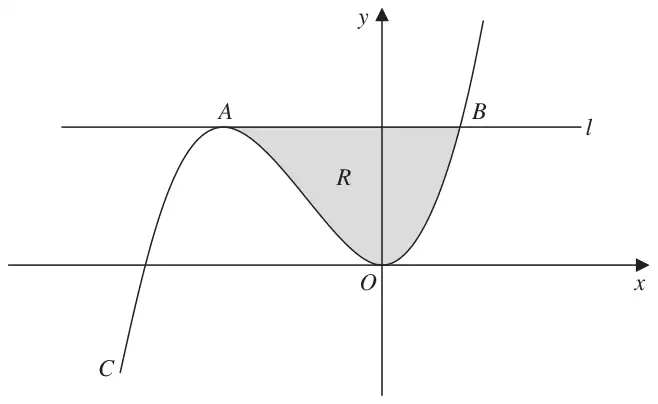
Figure 3 shows a sketch of part of the curve \(C\) with equation\[y = \frac{1}{8}x^3 + \frac{3}{4}x^2, \quad x \in \mathbb{R}\]
The curve \(C\) has a maximum turning point at the point \(A\) and a minimum turning point at the origin \(O\).
The line \(l\) touches the curve \(C\) at the point \(A\) and cuts the curve \(C\) at the point \(B\).
The \(x\) coordinate of \(A\) is \(-4\) and the \(x\) coordinate of \(B\) is 2.
The finite region \(R\), shown shaded in Figure 3, is bounded by the curve \(C\) and the line \(l\).
Use integration to find the area of the finite region \(R\). (7)
| Scheme | Marks |
|---|---|
| \(\displaystyle\int\left(\frac{1}{8}x^3 + \frac{3}{4}x^2\right)\mathrm{d}x = \frac{x^4}{32} + \frac{x^3}{4}\ \{+c\}\) | M1A1 |
| \(\left[\dfrac{x^4}{32} + \dfrac{x^3}{4}\right]_{-4}^{2} = \left(\dfrac{16}{32} + \dfrac{8}{4}\right) - \left(\dfrac{256}{32} + \dfrac{(-64)}{4}\right)\) or \(\left[\dfrac{x^4}{32} + \dfrac{x^3}{4}\right]_{-4}^{0} = (0) - \left(\dfrac{(-4)^4}{32} + \dfrac{(-4)^3}{4}\right)\) added to \(\left[\dfrac{x^4}{32} + \dfrac{x^3}{4}\right]_{0}^{2} = \left(\dfrac{(2)^4}{32} + \dfrac{(2)^3}{4}\right) - (0)\) | dM1 |
| Substitutes limits of 2 and \(-4\) into an “integrated function” and subtracts either way round. Or substitutes limits of 0 and \(-4\) and 2 and 0 into an “integrated function” and subtracts either way round and adds the two results. | |
| \(= \dfrac{21}{2}\) | A1 |
| \(\{\text{At } x = -4,\ y = -8 + 12 = 4\ \text{ or at } x = 2,\ y = 1 + 3 = 4\}\) | |
| Area of Rectangle \(= 6 \times 4 = 24\) or Area of Rectangles \(= 4 \times 4 = 16\) and \(2 \times 4 = 8\) | M1 |
| Evidence of \((4 - -2) \times\) their \(y_{-4}\) or \((4 - -2) \times\) their \(y_2\) or Evidence of \(4 \times\) their \(y_{-4}\) and \(2 \times\) their \(y_2\) | |
| So, area\((\mathrm{R}) = 24 - \dfrac{21}{2} = \dfrac{27}{2}\) | dddM1A1 |
| (7) | |
| Total 7 |
Notes
M1: \(x^n \to x^{n+1}\) on either term
A1: \(\dfrac{x^4}{32} + \dfrac{x^3}{4}\). Any correct simplified or un-simplified form. (+ c not required)
A1: \(\dfrac{21}{2}\) or 10.5
dddM1: Area rectangle – integrated answer. Dependent on all previous method marks and requires: Rectangle > integration > 0
A1: \(\dfrac{27}{2}\) or 13.5
Alternative:
| Scheme | Marks |
|---|---|
| \(\pm\displaystyle\int \text{"their4"} - \left(\frac{1}{8}x^3 + \frac{3}{4}x^2\right)\mathrm{d}x\) Line – curve. Condone missing brackets and allow either way round. | 4th M1 |
| \(= 4x - \dfrac{x^4}{32} - \dfrac{x^3}{4}\ \{+c\}\) M1: \(x^n \to x^{n+1}\) on either curve term A1ft: “\(-\dfrac{x^4}{32} - \dfrac{x^3}{4}\).” Any correct simplified or un-simplified form of their curve terms, follow through sign errors. (+ c not required) | 1st M1, 1st A1ft |
| \(\left[\ \right]_{-4}^{2} = \underline{\underline{\left(8 - \dfrac{16}{32} - \dfrac{8}{4}\right) - \left(-16 - \dfrac{256}{32} - \dfrac{(-64)}{4}\right)}}\) 2nd M1 Substitutes limits of 2 and \(-4\) into an “integrated curve” and subtracts either way round. 3rd M1 for \(\pm(\text{"}8\text{"} - \text{"}{-16}\text{"})\) Substitutes limits into the ‘line part’ and subtracts either way round. 2nd A1 for correct \(\pm\) (underlined expression). Now needs to be correct but allow \(\pm\) the correct expression. | 2nd M1, 3rd M1 2nd A1 |
| \(= \dfrac{27}{2}\) A1: \(\dfrac{27}{2}\) or 13.5 | 3rd A1 |
| If the final answer is -13.5 you can withhold the final A1 If -13.5 then “becomes” +13.5 allow the A1 |