
C2 June 2013 Q6
6.
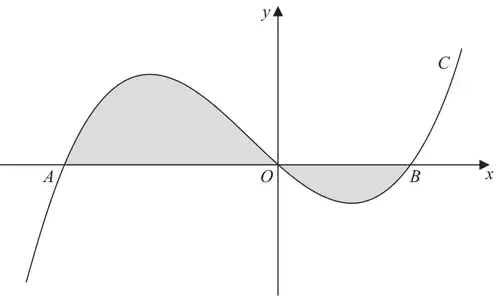
Figure 3 shows a sketch of part of the curve \(C\) with equation\[y = x(x + 4)(x - 2)\]The curve \(C\) crosses the \(x\)-axis at the origin \(O\) and at the points \(A\) and \(B\).
The finite region, shown shaded in Figure 3, is bounded by the curve \(C\) and the \(x\)-axis.
| Scheme | Marks |
|---|---|
| Seeing \(-4\) and 2. | B1 |
| (1) |
Notes
B1: Need both \(-4\) and 2. May see \((-4,0)\) and \((2,0)\) (correct) but allow \((0,-4)\) and \((0, 2)\) or \(A = -4\), \(B = 2\) or indeed any indication of -4 and 2 – check graph also
| Scheme | Marks |
|---|---|
| \(x(x + 4)(x - 2) = \underline{x^3 + 2x^2 - 8x}\) or \(\underline{x^3 - 2x^2 + 4x^2 - 8x}\) ( without simplifying) | B1 |
| \(\displaystyle\int (x^3 + 2x^2 - 8x)\,\mathrm{d}x = \frac{x^4}{4} + \frac{2x^3}{3} - \frac{8x^2}{2}\ \{+c\}\) or \(\dfrac{x^4}{4} - \dfrac{2x^3}{3} + \dfrac{4x^3}{3} - \dfrac{8x^2}{2}\ \{+c\}\) | M1A1ft |
| \(\left[\dfrac{x^4}{4} + \dfrac{2x^3}{3} - \dfrac{8x^2}{2}\right]_{-4}^{0} = (0) - \left(64 - \dfrac{128}{3} - 64\right)\) or \(\left[\dfrac{x^4}{4} + \dfrac{2x^3}{3} - \dfrac{8x^2}{2}\right]_{0}^{2} = \left(4 + \dfrac{16}{3} - 16\right) - (0)\) | dM1 |
| One integral \(= \pm 42\dfrac{2}{3}\) (42.6 or awrt 42.7 ) or other integral \(= \pm 6\dfrac{2}{3}\) (6.6 or awrt 6.7) | A1 |
| Hence Area \(= \text{"}their\,42\dfrac{2}{3}\text{"} + \text{"}their\,6\dfrac{2}{3}\text{"}\) or Area \(= \text{"}their\,42\dfrac{2}{3}\text{"} - \text{"}{-their}\,6\dfrac{2}{3}\text{"}\) | dM1 |
| \(= 49\dfrac{1}{3}\) or 49.3 or \(\dfrac{148}{3}\) (NOT \(-\dfrac{148}{3}\)) | A1 |
| (An answer of \(= 49\dfrac{1}{3}\) may not get the final two marks – check solution carefully) | |
| (7) | |
| [8] |
Notes
B1: Multiplies out cubic correctly (terms may not be collected, but if they are, mark collected terms here)
M1: Tries to integrate their expansion with \(x^n \to x^{n+1}\) for at least one of the terms
A1ft: completely correct integral following through from their CUBIC expansion (if only quadratic or quartic this is A0)
dM1: (dependent on previous M) substituting EITHER -\(a\) and 0 and subtracting either way round OR similarly for 0 and \(b\). If their limits \(-a\) and \(b\) are used in ONE integral, apply the Special Case below.
A1: Obtain either \(\pm 42\dfrac{2}{3}\) (or 42.6 or awrt 42.7)from the integral from -4 to 0 or \(\pm 6\dfrac{2}{3}\) (6.6 or awrt 6.7) from the integral from 0 to 2; NO follow through on their cubic (allow decimal or improper equivalents \(\dfrac{128}{3}\) or \(\dfrac{20}{3}\) ) isw such as subtracting from rectangles. This will be penalized in the next two marks, which will be M0A0.
dM1 (depends on first method mark) Correct method to obtain shaded area so adds two positive numbers (areas) together or uses their positive value minus their negative value, obtained from two separate definite integrals.
A1: Allow 49.3, 49.33, 49.333 etc. Must follow correct logical work with no errors seen.
For full marks on this question there must be two definite integrals, from -4 to 0 and from 0 to 2, though the evaluations for 0 may not be seen.
(Trapezium rule gets no marks after first two B marks)
Special Case: one integral only from \(-a\) to \(b\): B1M1A1 available as before, then
\(\left[\dfrac{x^4}{4} + \dfrac{2x^3}{3} - \dfrac{8x^2}{2}\right]_{-4}^{2} = \left(4 + \dfrac{16}{3} - 16\right) - \left(64 - \dfrac{128}{3} - 64\right) = -6\tfrac{2}{3} + 42\dfrac{2}{3} = \ldots.\) dM1 for correct use of their limits \(-a\) and \(b\) and subtracting either way round.
A1 for 36: NO follow through. Final M and A marks not available. Max 5/7 for part (b)