
C2 January 2010 Q7
7.
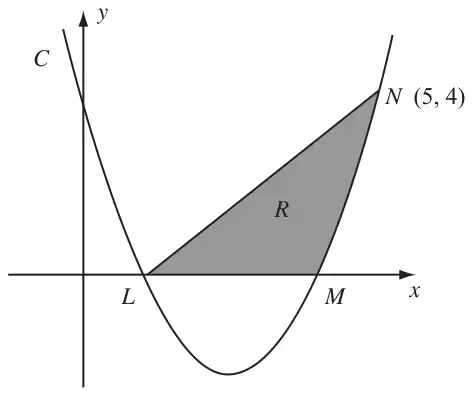
The curve \(C\) has equation \(y = x^2 - 5x + 4\). It cuts the \(x\)-axis at the points \(L\) and \(M\) as shown in Figure 2.
The finite region \(R\) is bounded by \(LN\), \(LM\) and the curve \(C\) as shown in Figure 2.
| Scheme | Marks |
|---|---|
| Puts \(y = 0\) and attempts to solve quadratic e.g. \((x - 4)(x - 1) = 0\) | M1 |
| Points are (1,0) and (4, 0) | A1 |
| (2) |
Notes
M1 for attempt to find \(L\) and \(M\)
A1 Accept \(x = 1\) and \(x = 4\) , then isw or accept \(L\) =(1,0) , \(M\) = (4,0)
Do not accept \(L\) = 1, \(M\) = 4 nor (0 , 1), (0 , 4) (unless subsequent work)
Do not need to distinguish \(L\) and \(M\). Answers imply M1A1.
| Scheme | Marks |
|---|---|
| \(x = 5\) gives \(y\) = 25 - 25 + 4 and so (5, 4) lies on the curve | B1cso |
| (1) |
Notes
See substitution, working should be shown, need conclusion which could be just \(y = 4\) or a tick. Allow \(y\) = 25 - 25 + 4 = 4 But not 25 - 25 + 4 = 4. ( \(y = 4\) may appear at start)
Usually 0 = 0 or 4 = 4 is B0
| Scheme | Marks |
|---|---|
| \(\displaystyle\int\left(x^2 - 5x + 4\right)\mathrm{d}x = \tfrac{1}{3}x^3 - \tfrac{5}{2}x^2 + 4x\qquad (+\,c)\) | M1A1 |
| (2) |
Notes
M1 for attempt to integrate \(x^2 \to kx^3\), \(x \to kx^2\) or \(4 \to 4x\)
A1 for correct integration of all three terms (do not need constant) isw.
Mark correct work when seen. So e.g. \(\tfrac{1}{3}x^3 - \tfrac{5}{2}x^2 + 4x\) is A1 then \(2x^3 - 15x^2 + 24x\) would be ignored as subsequent work.
| Scheme | Marks |
|---|---|
| Area of triangle \(= \tfrac{1}{2} \times 4 \times 4 = 8\) or \(\displaystyle\int(x - 1)\,\mathrm{d}x = \tfrac{1}{2}x^2 - x\) with limits 1 and 5 to give 8 | B1 |
| Area under the curve \(= \displaystyle\int_4^5\qquad \tfrac{1}{3} \times 5^3 - \tfrac{5}{2} \times 5^2 + 4 \times 5\quad \left[= -\frac{5}{6}\right]\) | M1 |
| \(\qquad\qquad\qquad\qquad\tfrac{1}{3} \times 4^3 - \tfrac{5}{2} \times 4^2 + 4 \times 4\quad \left[= -\dfrac{8}{3}\right]\) | M1 |
| \(\displaystyle\int_4^5 = -\frac{5}{6} - -\frac{8}{3} = \frac{11}{6}\) or equivalent (allow 1.83 or 1.8 here) | A1 cao |
| Area of \(R = 8 - \dfrac{11}{6} = 6\tfrac{1}{6}\) or \(\dfrac{37}{6}\) or \(6.16^r\) (not 6.17) | A1 cao |
| (5) | |
| [10] |
Notes
B1 for this triangle only (not triangle \(LMN\))
1st M1 for substituting 5 into their changed function
2nd M1 for substituting 4 into their changed function
Alternative method
\(\displaystyle\int_1^5 (x - 1) - (x^2 - 5x + 4)\,\mathrm{d}x + \int_1^4 x^2 - 5x + 4\,\mathrm{d}x\) can lead to correct answer
Constructs \(\displaystyle\int_1^5 (x - 1) - (x^2 - 5x + 4)\,\mathrm{d}x\) is B1
M1 for substituting 5 and 1 and subtracting in first integral
M1 for substituting 4 and 1 and subtracting in second integral
A1 for answer to first integral i.e. \(\tfrac{32}{3}\) (allow 10.7) and A1 for final answer as before..
Another alternative
\(\displaystyle\int_4^5 (x - 1) - (x^2 - 5x + 4)\,\mathrm{d}x + \textit{area of triangle LMP}\)
Constructs \(\displaystyle\int_4^5 (x - 1) - (x^2 - 5x + 4)\,\mathrm{d}x\) is B1
M1 for substituting 5 and 4 and subtracting in first integral
M1 for complete method to find area of triangle (4.5)
A1 for answer to first integral i.e. \(\tfrac{5}{3}\) and A1 for final answer as before.
Could also use
\(\displaystyle\int_4^5 (4x - 16) - (x^2 - 5x + 4)\,\mathrm{d}x + \textit{area of triangle LMN}\)
Similar scheme to previous one. Triangle has area 6
A1 for finding Integral has value \(\tfrac{1}{6}\) and A1 for final answer as before.