
C2 January 2009 Q5
5.
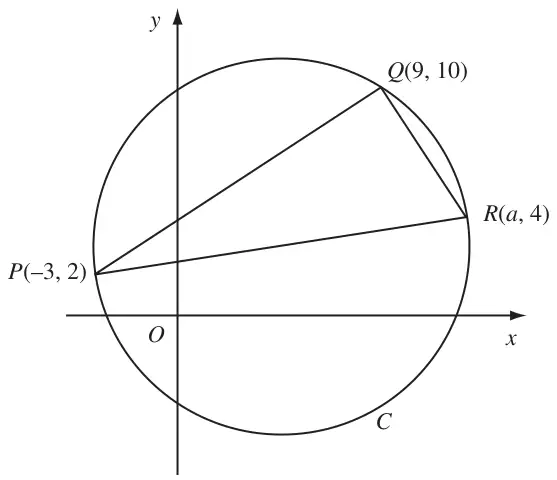
The points \(P(-3,\ 2)\), \(Q(9,\ 10)\) and \(R(a,\ 4)\) lie on the circle \(C\), as shown in Figure 2.
Given that \(PR\) is a diameter of \(C\),
| Scheme | Marks |
|---|---|
| \(PQ\!: \ m_1 = \dfrac{10 - 2}{9 - (-3)}\ \left(= \tfrac{2}{3}\right)\) and \(QR\!: \ m_2 = \dfrac{10 - 4}{9 - a}\) | M1 |
| \(m_1 m_2 = -1\!: \quad \dfrac{8}{12} \times \dfrac{6}{9 - a} = -1\qquad a = 13\qquad (*)\) | M1 A1 |
| (3) |
Alt for (a)
| Scheme | Marks |
|---|---|
| (a) Alternative method (Pythagoras) Finds all three of the following \(\left(9 - (-3)\right)^2 + (10 - 2)^2,\ (i.e.\,208)\ ,\quad (9 - a)^2 + (10 - 4)^2,\quad \left(a - (-3)\right)^2 + (4 - 2)^2\) | M1 |
| Using Pythagoras (correct way around) e.g. \(a^2 + 6a + 9 = 240 + a^2 - 18a + 81\) to form equation | M1 |
| Solve (or verify) for \(a\), \(a = 13\) (*) | A1 |
| (3) |
Further alternatives
| Scheme | Marks |
|---|---|
| (i) A number of methods find gradient of PQ = 2/3 then give perpendicular gradient is –3/2 This is M1 | M1 |
| They then proceed using equations of lines through point \(Q\) or by using gradient \(QR\) to obtain equation such as \(\dfrac{4 - 10}{a - 9} = -\dfrac{3}{2}\) M1 (may still have \(x\) in this equation rather than \(a\) and there may be a small slip) | M1 |
| They then complete to give (\(a\) )= 13 A1 | A1 |
| (ii) A long involved method has been seen finding the coordinates of the centre of the circle first. This can be done by a variety of methods Giving centre as (c, 3) and using an equation such as \((c - 9)^2 + 7^2 = (c + 3)^2 + 1^2\) (equal radii) or \(\dfrac{3 - 6}{c - 3} = -\dfrac{3}{2}\) M1 (perpendicular from centre to chord bisects chord) | M1 |
| Then using \(c\) ( = 5) to find \(a\) is M1 | M1 |
| Finally \(a = 13\) A1 | A1 |
| (iii) Vector Method: States PQ. QR = 0, with vectors stated 12i +8j and (9 – \(a\))i + 6j is M1 | M1 |
| Evaluates scalar product so \(108 - 12a + 48 = 0\) (M1) | M1 |
| solves to give \(a = 13\) (A1) | A1 |
Notes
M1-considers gradients of \(PQ\) and \(QR\) -must be \(y\) difference / \(x\) difference
(or considers three lengths as in alternative method)
M1 Substitutes gradients into product = -1 (or lengths into Pythagoras’ Theorem the correct way round )
A1 Obtains \(a = 13\) with no errors by solution or verification. Verification can score 3/3.
| Scheme | Marks |
|---|---|
| Centre is at (5, 3) | B1 |
| \(\left(r^2 =\right)\ (10 - 3)^2 + (9 - 5)^2\) or equiv., or \(\left(d^2 =\right)\ \left(13 - (-3)\right)^2 + (4 - 2)^2\) | M1 A1 |
| \((x - 5)^2 + (y - 3)^2 = 65\qquad\) or \(x^2 + y^2 - 10x - 6y - 31 = 0\) | M1 A1 |
| (5) | |
| [8] |
Alt for (b)
| Scheme | Marks |
|---|---|
| Uses \((x - a)^2 + (y - b)^2 = r^2\) or \(x^2 + y^2 + 2gx + 2fy + c = 0\) and substitutes (-3, 2), (9, 10) and (13, 4) then eliminates one unknown | M1 |
| Eliminates second unknown | M1 |
| Obtains \(g = -5,\ f = -3,\ c = -31\) or \(\quad a = 5,\ b = 3,\ \ r^2 = 65\) | A1, A1, B1cao |
| (5) |
Notes
Geometrical method: B1 for coordinates of centre – can be implied by use in part (b)
M1 for attempt to find \(r^2, d^2, r\) or \(d\) ( allow one slip in a bracket).
A1 cao. These two marks may be gained implicitly from circle equation
M1 for \((x \pm 5)^2 + (y \pm 3)^2 = k^2\) or \((x \pm 3)^2 + (y \pm 5)^2 = k^2\) ft their (5,3) Allow \(k^2\) non numerical.
A1 cao for whole equation and rhs must be 65 or \(\left(\sqrt{65}\right)^2\), (similarly B1 must be 65 or \(\left(\sqrt{65}\right)^2\), in alternative method for (b))