
C2 June 2007 Q7
7.
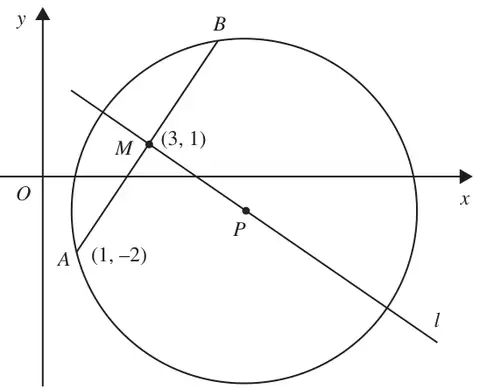
The points \(A\) and \(B\) lie on a circle with centre \(P\), as shown in Figure 3.
The point \(A\) has coordinates \((1, -2)\) and the mid-point \(M\) of \(AB\) has coordinates \((3, 1)\).
The line \(l\) passes through the points \(M\) and \(P\).
Given that the \(x\)-coordinate of \(P\) is 6,
| Scheme | Marks |
|---|---|
| Gradient of \(AM\): \(\dfrac{1 - (-2)}{3 - 1} = \dfrac{3}{2}\) or \(\dfrac{-3}{-2}\) | B1 |
| Gradient of \(l\): \(= -\dfrac{2}{3}\) M: use of \(m_1m_2 = -1\), or equiv. | M1 |
| \(y - 1 = -\dfrac{2}{3}(x - 3)\) or \(\dfrac{y - 1}{x - 3} = -\dfrac{2}{3}\) \([3y = -2x + 9]\) (Any equiv. form) | M1 A1 |
| (4) |
Notes
2nd M1: eqn. of a straight line through \((3, 1)\) with any gradient except 0 or \(\infty\).
Alternative: Using \((3, 1)\) in \(y = mx + c\) to find a value of \(c\) scores M1, but an equation (general or specific) must be seen.
Having coords the wrong way round, e.g. \(y - 3 = -\dfrac{2}{3}(x - 1)\), loses the 2nd M mark unless a correct general formula is seen, e.g. \(y - y_1 = m(x - x_1)\).
If the point \(P(6, -1)\) is used to find the gradient of \(MP\), maximum marks are (a) B0 M0 M1 A1 (b) B0.
| Scheme | Marks |
|---|---|
| \(x = 6\): \(\;3y = -12 + 9 = -3 \quad y = -1\) (or show that for \(y = -1,\ x = 6\)) (*) (A conclusion is not required). | B1 |
| (1) |
| Scheme | Marks |
|---|---|
| \((r^2 =)\ (6 - 1)^2 + (-1 - (-2))^2\) M: Attempt \(r^2\) or \(r\) N.B. Simplification is not required to score M1 A1 | M1 A1 |
| \((x \pm 6)^2 + (y \pm 1)^2 = k,\quad k \neq 0\) (Value for \(k\) not needed, could be \(r^2\) or \(r\)) | M1 |
| \((x - 6)^2 + (y + 1)^2 = 26\) (or equiv.) Allow \(\left(\sqrt{26}\right)^2\) or other exact equivalents for 26. (But… \((x - 6)^2 + (y - -1)^2 = 26\) scores M1 A0) (Correct answer with no working scores full marks) | A1 |
| (4) | |
| 9 |
Notes
1st M1: Condone one slip, numerical or sign, inside a bracket.
Must be attempting to use points \(P(6, -1)\) and \(A(1, -2)\), or perhaps \(P\) and \(B\). (Correct coordinates for \(B\) are \((5, 4)\)).
1st M alternative is to use a complete Pythag. method on triangle \(MAP\), n.b. \(MP = MA = \sqrt{13}\).
Special case:
If candidate persists in using their value for the \(y\)-coordinate of \(P\) instead of the given \(-1\), allow the M marks in part (c) if earned.