
C2 January 2006 Q9
9.
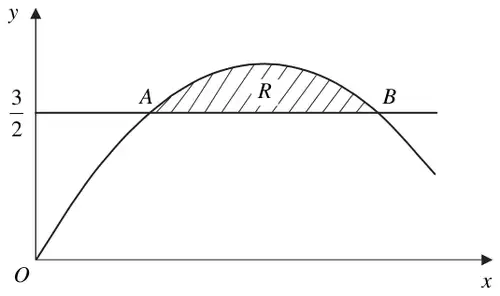
Figure 3 shows the shaded region \(R\) which is bounded by the curve \(y = -2x^2 + 4x\) and the line \(y = \dfrac{3}{2}\). The points \(A\) and \(B\) are the points of intersection of the line and the curve.
Find
| Scheme | Marks |
|---|---|
| \(\dfrac{3}{2} = -2x^2 + 4x\) | M1 |
| \(4x^2 - 8x + 3\ (= 0)\) | A1 |
| \((2x - 1)(2x - 3) = 0\) | M1 |
| \(\underline{x = \tfrac{1}{2},\ \tfrac{3}{2}}\) | A1 |
| (4) |
Notes
1st M1 for forming a correct equation
1st A1 for a correct 3TQ (condone missing =0 but must have all terms on one side)
2nd M1 for attempting to solve appropriate 3TQ
| Scheme | Marks |
|---|---|
| Area of \(R = \displaystyle\int_{\frac{1}{2}}^{\frac{3}{2}} \left(-2x^2 + 4x\right)\mathrm{d}x - \frac{3}{2}\) (for \(-\tfrac{3}{2}\)) | B1 |
| \(\displaystyle\int\left(-2x^2 + 4x\right)\mathrm{d}x = \left[-\frac{2}{3}x^3 + 2x^2\right]\) (Allow \(\pm[\ ]\), accept \(\tfrac{4}{2}x^2\)) | M1 [A1] |
| \(\displaystyle\int_{\frac{1}{2}}^{\frac{3}{2}} \left(-2x^2 + 4x\right)\mathrm{d}x = \left(-\frac{2}{3} \times \frac{3^3}{2^3} + 2 \times \frac{3^2}{2^2}\right) -, \left(-\frac{2}{3} \times \frac{1}{2^3} + 2 \times \frac{1}{2^2}\right)\) \(\left(= \dfrac{11}{6}\right)\) | M1 M1 |
| Area of \(R = \dfrac{11}{6} - \dfrac{3}{2} = \underline{\dfrac{1}{3}}\) (Accept exact equivalent but not \(0.33\ldots\)) | A1cao |
| (6) | |
| (10 marks) |
Notes
B1 for subtraction of \(\tfrac{3}{2}\). Either “curve – line” or “integral – rectangle”
1st M1 for some correct attempt at integration \(\left(x^n \to x^{n+1}\right)\)
1st A1 for \(-\tfrac{2}{3}x^3 + 2x^2\) only i.e. can ignore \(-\tfrac{3}{2}x\)
2nd M1 for some correct use of their \(\tfrac{3}{2}\) as a limit in integral
3rd M1 for some correct use of their \(\tfrac{1}{2}\) as a limit in integral and subtraction either way round
Special Case Line – curve gets B0 but can have the other A marks provided final answer is \(+\tfrac{1}{3}\).