
C2 January 2005 Q8
8.
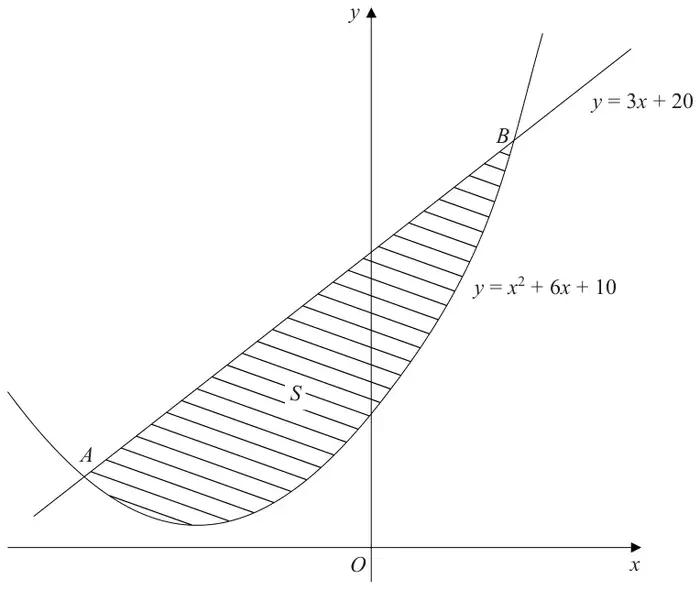
The line with equation \(y = 3x + 20\) cuts the curve with equation \(y = x^2 + 6x + 10\) at the points \(A\) and \(B\), as shown in Figure 2.
(a) Use algebra to find the coordinates of \(A\) and the coordinates of \(B\). (5)
The shaded region \(S\) is bounded by the line and the curve, as shown in Figure 2.
(b) Use calculus to find the exact area of \(S\). (7)
| Scheme | Marks |
|---|---|
| \(x^2 + 6x + 10 = 3x + 20\) | M1 |
| \(\Rightarrow x^2 + 3x - 10 = 0\) \((x + 5)(x - 2) = 0\) so \(x =, -5\) or 2 | M1, A1 |
| sub for \(y\) in \(y = 3x + 20,\ y = 5\) or 26 | M1, A1 |
| (5) |
Notes
1st M1 for putting curve = line
3rd M1 for obtaining at least one \(y\) value. Don’t need A and B identified.
| Scheme | Marks |
|---|---|
| line \(-\) curve \(=, 10 - 3x - x^2\) | M1, A1 |
| \(\displaystyle\int(10 - 3x - x^2)\,dx = 10x - \frac{3}{2}x^2 - \frac{x^3}{3}\) | M1 A2/1/0ft |
| \(\left[10x - \dfrac{3}{2}x^2 - \dfrac{x^3}{3}\right]_{-5}^{2} = \left(20 - \dfrac{3}{2} \times 4 - \dfrac{8}{3}\right) - \left(-50 - \dfrac{3}{2} \times 25 + \dfrac{125}{3}\right)\) | M1 |
| \(= 11\tfrac{1}{3} - -45\tfrac{5}{6} = \underline{57\tfrac{1}{6}}\) | A1 |
| (7) | |
| (12 marks) |
ALT (b)
| Scheme | Marks |
|---|---|
| \(\displaystyle\int(x^2 + 6x + 10)\,dx = \frac{x^3}{3} + 3x^2 + 10x\) | M1 A2 |
| use of limits \(= \left(\tfrac{8}{3} + 12 + 20\right) - \left(-\dfrac{125}{3} + 75 - 50\right) = (51\tfrac{1}{3})\) | M1 |
| Area of Trapezium \(= \dfrac{1}{2}(5 + 26)(2 - -5) = (108\tfrac{1}{2})\) | B1ft |
| Shaded area = Trapezium \(- \displaystyle\int = 108\tfrac{1}{2} - 51\tfrac{1}{3} = 57\tfrac{1}{6}\) | M1 A1 |
| (7) |
(corrected from the printed mark scheme: the values in brackets after “use of limits” and “Area of Trapezium” were printed the wrong way round, as \((108\tfrac{1}{2})\) and \((51\tfrac{1}{3})\))
Notes
1st M1 for \(\pm(10 - 3x - x^2)\)
3rd M1 (2nd on ALT) for using their limits, ft their \(x\) values from (a)