
C1 January 2012 Q10
10.
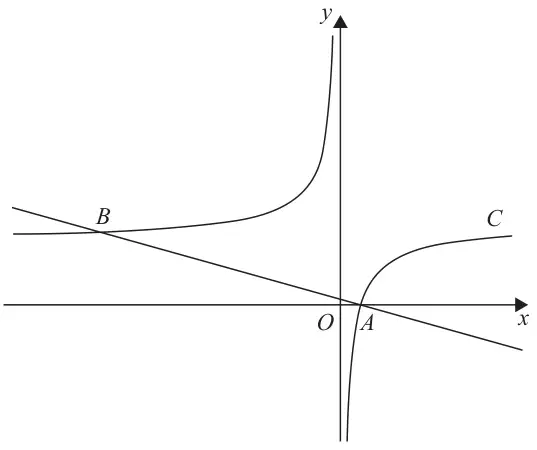
Figure 2 shows a sketch of the curve \(C\) with equation\[y = 2 - \frac{1}{x}, \qquad x \neq 0\]The curve crosses the \(x\)-axis at the point \(A\).
The normal to \(C\) at \(A\) meets \(C\) again at the point \(B\), as shown in Figure 2.
| Scheme | Marks |
|---|---|
| \(\left(\dfrac{1}{2}, 0\right)\) | B1 |
| (1) |
Notes
B1: accept \(x = \dfrac{1}{2}\) if evidence that \(y = 0\) has been used. Can be written on graph. Use ISW
| Scheme | Marks |
|---|---|
| \(\dfrac{\mathrm{d}y}{\mathrm{d}x} = x^{-2}\) | M1A1 |
| At \(x = \dfrac{1}{2}\), \(\dfrac{\mathrm{d}y}{\mathrm{d}x} = \left(\dfrac{1}{2}\right)^{-2} = 4 \quad (= m)\) | A1 |
| Gradient of normal \(= -\dfrac{1}{m} \qquad \left(= -\dfrac{1}{4}\right)\) | M1 |
| Equation of normal: \(y - 0 = -\dfrac{1}{4}\left(x - \dfrac{1}{2}\right)\) | M1 |
| \(2x + 8y - 1 = 0 \qquad (*)\) | A1cso |
| (6) |
Notes
1st M1: for \(kx^{-2}\) even if the ’2’ is not differentiated to zero. If no evidence of \(\dfrac{\mathrm{d}y}{\mathrm{d}x}\) seen then 0/6
1st A1: for \(x^{-2}\) (o.e.) only
2nd A1: for using \(x = 0.5\) to get \(m = 4\) (correctly) (or \(m = 1/0.25\))
To score final A1cso must see at least one intermediate equation for the line after \(m = 4\)
2nd M1: for using the perpendicular gradient rule on their \(m\) coming from their \(\dfrac{\mathrm{d}y}{\mathrm{d}x}\)
Their \(m\) must be a value not a letter.
3rd M1: for using a changed gradient (based on \(y^{\prime}\)) and their \(A\) to find equation of line
3rd A1cso: for reaching printed answer with no incorrect working seen.
Accept \(2x + 8y = 1\) or equivalent equations with \(\pm 2x\) and \(\pm 8y\)
Trial and improvement requires sight of first equation.
| Scheme | Marks |
|---|---|
| \(2 - \dfrac{1}{x} = -\dfrac{1}{4}x + \dfrac{1}{8}\) | M1 |
| \([\,= 2x^2 + 15x - 8 = 0\,]\) or \([\,8y^2 - 17y = 0\,]\) \((2x - 1)(x + 8) = 0\) leading to \(x = \ldots\) | M1 |
| \(x = \left[\dfrac{1}{2}\right]\) or \(-8\) | A1 |
| \(y = \dfrac{17}{8}\) (or exact equivalent) | A1ft |
| (4) | |
| (11 marks) |
Notes
1st M1: for attempt to form a suitable equation in one variable. Do not penalise poor use of brackets etc.
2nd M1: for simplifying their equation to a 3TQ and attempting to solve. May be \(\Rightarrow\) by \(x = -8\)
1st A1: for \(x = -8\) (ignore a second value). If found \(y\) first allow ft for \(x\) if \(x < 0\)
2nd A1ft: for \(y = \dfrac{17}{8}\) Follow through their \(x\) value in line or curve provided answer is \(> 0\)
This second A1 is dependent on both M marks