
C1 June 2008 Q10
10.
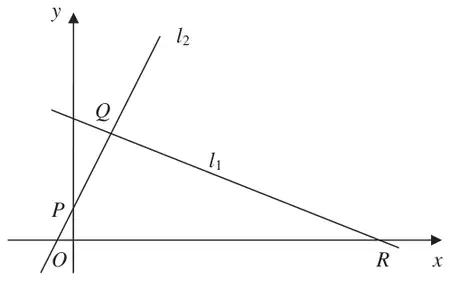
The points \(Q\,(1, 3)\) and \(R\,(7, 0)\) lie on the line \(l_1\), as shown in Figure 2.
The length of \(QR\) is \(a\sqrt{5}\).
The line \(l_2\) is perpendicular to \(l_1\), passes through \(Q\) and crosses the \(y\)-axis at the point \(P\), as shown in Figure 2.
Find
| Scheme | Marks |
|---|---|
| \(QR = \sqrt{(7 - 1)^2 + (0 - 3)^2}\) | M1 |
| \(= \sqrt{36 + 9}\) or \(\sqrt{45}\) (condone \(\pm\)) | A1 |
| \(= 3\sqrt{5}\) or \(a = 3\) (\(\pm 3\sqrt{5}\) etc is A0) | A1 |
| (3) |
Notes
Rules for quoting formula: For an M mark, if a correct formula is quoted and some correct substitutions seen then M1 can be awarded, if no values are correct then M0. If no correct formula is seen then M1 can only be scored for a fully correct expression.
M1: for attempting \(QR\) or \(QR^2\). May be implied by \(6^2 + 3^2\)
1st A1: for as printed or better. Must have square root. Condone \(\pm\)
| Scheme | Marks |
|---|---|
| Gradient of \(QR\) (or \(l_1\)) \(= \dfrac{3 - 0}{1 - 7}\) or \(\dfrac{3}{-6}, = -\dfrac{1}{2}\) | M1, A1 |
| Gradient of \(l_2\) is \(-\dfrac{1}{-\frac{1}{2}}\) or 2 | M1 |
| Equation for \(l_2\) is: \(\quad y - 3 = 2(x - 1)\) or \(\frac{y - 3}{x - 1} = 2\) [or \(y = 2x + 1\)] | M1 A1ft |
| (5) |
Notes
1st M1: for attempting gradient of \(QR\)
1st A1: for - 0.5 or \(-\tfrac{1}{2}\), can be implied by gradient of \(l_2 = 2\)
2nd M1: for an attempt to use the perpendicular rule on their gradient of \(QR\).
3rd M1: for attempting equation of a line using \(Q\) with their changed gradient.
2nd A1ft: requires all 3 Ms but can ft their gradient of \(QR\).
\(y = 2x + 1\) with no working. Send to review.
| Scheme | Marks |
|---|---|
| \(P\) is \((0, 1)\) (allow “\(x = 0,\ y = 1\)” but it must be clearly identifiable as \(P\)) | B1 |
| (1) |
| Scheme | Marks |
|---|---|
| \(PQ = \sqrt{\left(1 - x_P\right)^2 + \left(3 - y_P\right)^2}\) | M1 |
| \(PQ = \sqrt{1^2 + 2^2} = \sqrt{5}\) | A1 |
| Area of triangle is \(\tfrac{1}{2}QR\times PQ = \tfrac{1}{2}3\sqrt{5}\times\sqrt{5}, = \dfrac{15}{2}\) or 7.5 | dM1, A1 |
| (4) | |
| (13 marks) |
Notes
1st M1: for attempting \(PQ\) or \(PQ^2\) follow through their coordinates of \(P\)
1st A1: for \(PQ\) as one of the given forms.
2nd dM1: for correct attempt at area of the triangle. Follow through their value of \(a\) and their \(PQ\).
This M mark is dependent upon the first M mark
2nd A1: for 7.5 or some exact equivalent. Depends on both Ms. Some working must be seen.
Determinant Method
| Scheme | Marks |
|---|---|
| e.g\((0 + 0 + 7) - (1 + 21 + 0)\) \(= -15\) (o.e.) M1 for attempt -at least one value in each bracket correct . A1 if correct (\(\pm 15\)) | M1 A1 |
| Area \(= \tfrac{1}{2}\left|-15\right|, = 7.5\) M1 for correct area formula A1 for 7.5 | M1 A1 |
ALT
| Scheme | Marks |
|---|---|
| Use \(QS\) where \(S\) is \((1, 0)\) | |
| 1st M1 for attempting area of \(OPQS\) and \(QSR\) and \(OPR\). Need all 3. | M1 |
| 1st A1 for \(OPQS = \tfrac{1}{2}(1 + 3)\times 1 = 2\), \(QSR = 9\), \(OPR = \tfrac{7}{2}\) | A1 |
| 2nd dM1 for \(OPQS + QSR - OPR = \ldots\) Follow through their values. | dM1 |
| 2nd A1 for 7.5 | A1 |
MR: Misreading \(x\)-axis for \(y\)-axis for \(P\). Do NOT use MR rule as this oversimplifies the question. They can only get M marks in (d) if they use \(PQ\) and \(QR\).