
October 2021 Paper 2 Q11
11
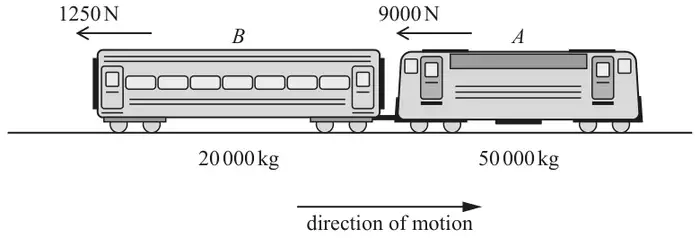
A train consists of an engine \(A\) of mass \(50\,000\,\mathrm{kg}\) and a carriage \(B\) of mass \(20\,000\,\mathrm{kg}\). The engine and carriage are connected by a rigid coupling. The coupling is modelled as light and horizontal.
The resistances to motion acting on \(A\) and \(B\) are \(9000\,\mathrm{N}\) and \(1250\,\mathrm{N}\) respectively (see diagram).
The train passes through station \(P\) with speed \(15\,\mathrm{m\,s^{-1}}\) and moves along a straight horizontal track with constant acceleration \(0.01\,\mathrm{m\,s^{-2}}\) towards station \(Q\). The distance between \(P\) and \(Q\) is \(12.95\,\mathrm{km}\).
For the train’s motion between \(P\) and \(Q\), determine the following.
| Scheme | Marks | AO |
|---|---|---|
| M1 | 3.4 | |
| \(12950 = 15t + 0.5(0.01)t^2\) leading to \(t = \ldots\) | A1 | 1.1 |
| 11.7 (minutes) | A1 | 1.1 |
| [3] |
Notes
M1: Use of \(s = ut + \frac{1}{2}at^2\)
A1: Correct equation and attempt to solve
Consistent values used
A1: BC cao (exact value is \(11\frac{2}{3}\))
| Scheme | Marks | AO |
|---|---|---|
| \(D - 1250 - 9000 = 70000(0.01)\) | M1 | 3.3 |
| \(10\,950\) (N) | A1 | 1.1 |
| [2] |
Notes
M1: N2L applied to the whole system, correct number of terms (allow sign errors)
A1: cao
| Scheme | Marks | AO |
|---|---|---|
| \(\text{'}10950\text{'} - 9000 - T_C = 50000(0.01)\) or \(T_C - 1250 = 20000(0.01)\) | M1 | 3.3 |
| 1450 (N) | A1 | 1.1 |
| [2] |
Notes
M1: N2L applied correctly to either \(A\) or \(B\), correct number of terms (allow sign errors)
A1: cao