
June 2019 Paper 2 Q11
11 Two small balls \(P\) and \(Q\) have masses 3 kg and 2 kg respectively. The balls are attached to the ends of a string. \(P\) is held at rest on a rough horizontal surface. The string passes over a pulley which is fixed at the edge of the surface. \(Q\) hangs vertically below the pulley at a height of 2 m above a horizontal floor.
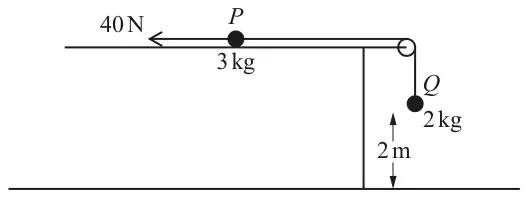
The system is initially at rest with the string taut. A horizontal force of magnitude 40 N acts on \(P\) as shown in the diagram.
\(P\) is released and moves directly away from the pulley. A constant frictional force of magnitude 8 N opposes the motion of \(P\). It is given that \(P\) does not leave the horizontal surface and that \(Q\) does not reach the pulley in the subsequent motion.
The balls are modelled as particles, the pulley is modelled as being small and smooth, and the string is modelled as being light and inextensible.
When the balls have been in motion for 0.5 seconds, the string breaks.
| Scheme | Marks | AO |
|---|---|---|
| M1* | 3.3 | |
| For \(P\): \(40 - T - 8 = 3a\) | A1 | 1.1 |
| For \(Q\): \(T - 2g = 2a\) | A1 | 1.1 |
| \(32 - 2g = 5a \Rightarrow a = \ldots\) | Dep*M1 | 1.1 |
| \(a = 2.48\ \text{m}\,\text{s}^{-2}\) | A1 | 2.2a |
| [5] |
Notes
M1*: Attempt N2L for \(P\) or \(Q\). Must include correct number of terms – use of weight for mass is M0
Dep*M1: Attempt to solve simultaneous equations
A1: AG Must show sufficient working to justify the given answer
M1 A2 for \(40 - 8 - 2g = 5a\) for M1 must have correct number of terms and mass must be 5 not \(5g\)
| Scheme | Marks | AO |
|---|---|---|
| \(T - 2g = 2(2.48)\) | M1 | 3.4 |
| \(T = 24.56\,\text{N}\) | A1 | 1.1 |
| [2] |
Notes
M1: Substitute given value of \(a\) into either equation. Must include correct number of terms – use of weight for mass is M0
A1: cao Allow 24.6
| Scheme | Marks | AO |
|---|---|---|
| \(v = 2.48(0.5)\) | B1 | 3.4 |
| \(s = 0.5(2.48)(0.5)^2\) | B1 | 3.4 |
| M1 | 3.1b | |
| \(-(2 + 0.31) = 1.24t - 0.5(9.8)t^2\) | A1 | 1.1 |
| \(t = 0.825\,\text{s}\) | A1 | 2.2a |
| [5] |
Notes
B1: Speed after 0.5 seconds 1.24
B1: Distance travelled in this time 0.31
M1: Applying \(s = ut + 0.5at^2\) correctly — allow sign errors. M0 if not using relevant displacement
A1: BC 0.8246986…
Alternative
| Scheme | Marks |
|---|---|
| \(v = 2.48(0.5)\) | B1 |
| \(s = 0.5(2.48)(0.5)^2\) | B1 |
| \(0 = 1.24^2 - 2(9.8)s \;\; (\Rightarrow s = 0.0784)\) \(2 + 0.31 + 0.0784 = 0.5(9.8)t_1^{\,2}\) | M1 |
| \(t_1 = 0.698\) | A1 |
| \(t = 0.825\) | A1 |
B1: Speed after 0.5 seconds 1.24
B1: Distance travelled in this time 0.31
M1: Complete method to calculate the time down
A1: Correct value for time down
| Scheme | Marks | AO |
|---|---|---|
| \(v^2 = 1.24^2 + 2(-9.8)(-2.31)\) | M1 | 3.3 |
| \(v = 6.84\,\text{m}\,\text{s}^{-1}\) | A1 | 1.1 |
| [2] |
Notes
M1: Applying \(v^2 = u^2 + 2as\) correctly with their 1.24 and 2.31 or any other complete method. M0 if not using total time or relevant displacement
A1: Allow 6.85 6.8420464…
| Scheme | Marks | AO |
|---|---|---|
| \(19.6\,\text{N}\) | B1 | 3.4 |
| [1] |
Notes
Accept \(2g\)
| Scheme | Marks | AO |
|---|---|---|
| e.g. include a more accurate value for \(g\) e.g. include a variable resistance in the model rather than a constant e.g. include the dimension of the pulley in the model so that the string is not parallel to the table e.g. include a frictional force at the pulley | B1 | 3.5c |
| [1] |