
October 2020 Paper 1 Q5
5 Fig. 5.1 shows part of the curve \(y = x^{\frac{1}{2}}\). P is the point (1, 1) and Q is the point on the curve with \(x\)-coordinate \(1 + h\).
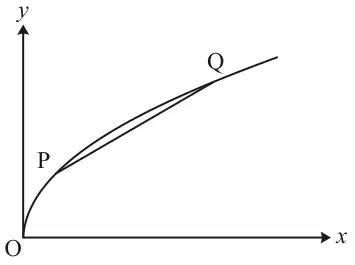
Table 5.2 shows, for different values of \(h\), the coordinates of P, the coordinates of Q, the change in \(y\) from P to Q and the gradient of the chord PQ.
| \(x\) for P | \(y\) for P | \(h\) | \(x\) for Q | \(y\) for Q | change in \(y\) | gradient PQ |
|---|---|---|---|---|---|---|
| 1 | 1 | 1 | ||||
| 1 | 1 | 0.1 | 1.1 | 1.048 809 | 0.048 809 | 0.488 088 |
| 1 | 1 | 0.01 | 1.01 | 1.004 988 | 0.004 988 | 0.498 756 |
| 1 | 1 | 0.001 | 1.001 | 1.000 500 | 0.000 500 | 0.499 875 |
Table 5.2
(a) Fill in the missing values for the case \(h = 1\) in Table 5.2. Give your answers correct to 6 decimal places where necessary. [1]
(b) Explain how the sequence of values in the last column of Table 5.2 relates to the gradient of the curve \(y = x^{\frac{1}{2}}\) at the point P. [1]
(c) Use calculus to find the gradient of the curve at the point P. [2]
| Scheme | Marks | AO | ||||
|---|---|---|---|---|---|---|
| B1 | 1.1a | ||||
| [1] |
Notes
B1: cao Must be to 6 dp
Condone truncated to 6 dp (1.414213 etc.)
| Scheme | Marks | AO |
|---|---|---|
| The limit of the sequence of gradients as \(h\) tends to zero is the gradient of (the tangent to) the curve. (The sequence of gradients tends to 0.5.) | B1 | 2.4 |
| [1] |
Notes
B1: Must communicate the idea of a limit as \(h\) tends to zero but need not be expressed in that way
Do not allow “as \(h\) decreases, gradient increases” without “towards 0.5” or “towards a limit” or “towards the gradient of the curve/tangent”
| Scheme | Marks | AO |
|---|---|---|
| \(\dfrac{\mathrm{d}y}{\mathrm{d}x} = \dfrac{1}{2}x^{-\frac{1}{2}}\) | M1 | 1.1a |
| When \(x = 1,\ \dfrac{\mathrm{d}y}{\mathrm{d}x} = \dfrac{1}{2} \times 1^{-\frac{1}{2}} = \dfrac{1}{2}\) | A1 | 1.1 |
| [2] |
Notes
M1: Differentiating