
November 2021 Mechanics Q3
3.
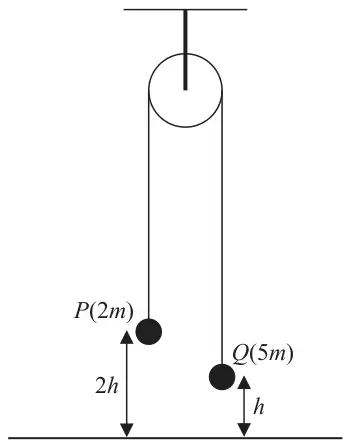
A ball \(P\) of mass \(2m\) is attached to one end of a string.
The other end of the string is attached to a ball \(Q\) of mass \(5m\).
The string passes over a fixed pulley.
The system is held at rest with the balls hanging freely and the string taut.
The hanging parts of the string are vertical with \(P\) at a height \(2h\) above horizontal ground and with \(Q\) at a height \(h\) above the ground, as shown in Figure 1.
The system is released from rest.
In the subsequent motion, \(Q\) does not rebound when it hits the ground and \(P\) does not hit the pulley.
The balls are modelled as particles.
The string is modelled as being light and inextensible.
The pulley is modelled as being small and smooth.
Air resistance is modelled as being negligible.
Using this model,
In reality, the string will not be inextensible.
| Scheme | Marks | AO |
|---|---|---|
| (i) Equation of motion for \(P\) | M1 | 3.3 |
| \(T - 2mg = 2ma\) | A1 | 1.1b |
| (ii) Equation of motion for \(Q\) | M1 | 3.3 |
| \(5mg - T = 5ma\) | A1 | 1.1b |
| N.B. (allow (\(-a\)) in both equations) | ||
| (4) |
Notes
M1: Translate situation into the model and set up the equation of motion for \(P\) (must contain \(T\) and \(a\))
A1: Correct equation
M1: Translate situation into the model and set up the equation of motion for \(Q\) (must contain \(T\) and \(a\))
A1: Correct equation
N.B. Allow the above 4 marks if the equations appear in (b).
If \(m\)’s are omitted consistently, max (a) M1A0M1A0 (b) M1A0M1M1A1M1A0
| Scheme | Marks | AO |
|---|---|---|
| Solve equations for \(a\) or use whole system equation and solve for \(a\) | M1 | 3.4 |
| \(a = \dfrac{3g}{7} = 4.2\) | A1 | 1.1b |
| \(v = \sqrt{2 \times \dfrac{3g}{7} \times h} = \sqrt{8.4h}\) or \(v^2 = 2 \times \dfrac{3g}{7} \times h\ (= 8.4h)\) | M1 | 1.1b |
| \(0 = \dfrac{6gh}{7} - 2gH\) | M1 | 1.1b |
| \(H = \dfrac{3h}{7}\) | A1 | 1.1b |
| Total height = \(2h + h + H\) | M1 | 2.1 |
| Total height = \(\dfrac{24h}{7}\) | A1 | 1.1b |
| (7) |
Notes
M1: Solve for \(a\)
A1: Allow 4.2 (\(\text{m s}^{-2}\)) or must be in terms of \(g\) only.
N.B. Allow the above 2 marks if they appear in (a).
M1: Complete method to produce an expression for \(v\) or \(v^2\) in terms \(h\), using their \(a\)
M1: Complete method to produce an expression for \(H\) in terms of \(h\), using \(a = -g\) and \(v = 0\)
A1: Correct expression for \(H\)
M1: Complete method to find the total distance
A1: cao but allow \(3.4h\) or better
| Scheme | Marks | AO |
|---|---|---|
| e.g. The distance that \(Q\) falls to the ground would not be exactly \(h\) oe | B1 | 3.5b |
| (1) |
Notes
B1: B0 if any incorrect extras are given
| Scheme | Marks | AO |
|---|---|---|
| e.g. The accelerations of the balls would not have equal magnitude (allow ‘wouldn’t be the same’ oe) B0 if they say ‘inextensible \(\Rightarrow\) acceleration same’ | B1 | 3.5a |
| (1) | ||
| (13 marks) |
Notes
B1: B0 if any incorrect extras are given or for an incorrect statement e.g. tension is not constant so accelerations will be different