
June 2019 Paper 1 Q10
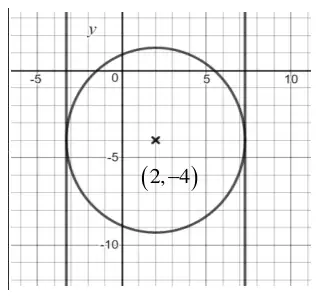
10. A circle \(C\) has equation\[x^2 + y^2 - 4x + 8y - 8 = 0\]
The straight line with equation \(x = k\), where \(k\) is a constant, is a tangent to \(C\).
| Scheme | Marks | AO |
|---|---|---|
| \(x^2 + y^2 - 4x + 8y - 8 = 0\) | ||
| Attempts \((x - 2)^2 + (y + 4)^2 - 4 - 16 - 8 = 0\) | M1 | 1.1b |
| (i) Centre \((2, -4)\) | A1 | 1.1b |
| (ii) Radius \(\sqrt{28}\) oe Eg \(2\sqrt{7}\) | A1 | 1.1b |
| (3) |
Notes
M1: Attempts to complete the square. Look for \((x \pm 2)^2 + (y \pm 4)^2 \ldots\)
If a candidate attempts to use \(x^2 + y^2 + 2gx + 2fy + c = 0\) then it may be awarded for a centre of \((\pm 2, \pm 4)\) Condone \(a = \pm 2, b = \pm 4\)
A1: Centre \((2, -4)\) This may be written separately as \(x = 2, y = -4\) BUT \(a = 2, b = -4\) is A0
A1: Radius \(\sqrt{28}\) or \(2\sqrt{7}\) isw after a correct answer
| Scheme | Marks | AO |
|---|---|---|
| Attempts to add/subtract \(\text{‘}r\text{’}\) from ‘2’ | M1 | 3.1a |
| \(k = 2 \pm \sqrt{28}\) | A1ft | 1.1b |
| (2) | ||
| (5 marks) |
Notes
M1: Attempts to add or subtract their radius from their 2.
Alternatively substitutes \(y = -4\) into circle equation and finds \(x/k\) by solving the quadratic equation by a suitable method.
A third (and more difficult) method would be to substitute \(x = k\) into the equation to form a quadratic eqn in \(y \Rightarrow y^2 + 8y + k^2 - 4k - 8 = 0\) and use the fact that this would have one root.
E.g. \(b^2 - 4ac = 0 \Rightarrow 64 - 4\left(k^2 - 4k - 8\right) = 0 \Rightarrow k = ..\) Condone slips but the method must be sound.
A1ft: \(k = 2 + \sqrt{28}\) and \(k = 2 - \sqrt{28}\) Follow through on their 2 and their \(\sqrt{28}\)
If decimals are used the values must be calculated. Eg \(k = 2 \pm 5.29 \to k = 7.29, k = -3.29\)
Accept just \(2 \pm \sqrt{28}\) or equivalent such as \(2 \pm 2\sqrt{7}\)
Condone \(x = 2 + \sqrt{28}\) and \(x = 2 - \sqrt{28}\) but not \(y = 2 + \sqrt{28}\) and \(y = 2 - \sqrt{28}\)