
June 2018 Paper 1 Q9
9.
\[\mathrm{g}(x) = 4x^3 - 12x^2 - 15x + 50\]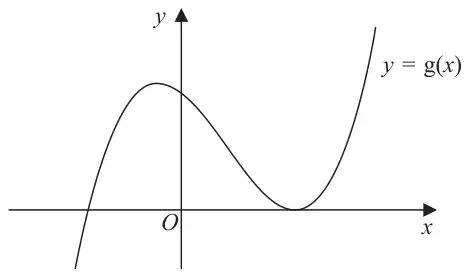
Figure 2 shows a sketch of part of the curve with equation \(y = \mathrm{g}(x)\)
| Scheme | Marks | AO |
|---|---|---|
| \((\mathrm{g}(-2)) = 4 \times -8 - 12 \times 4 - 15 \times -2 + 50\) | M1 | 1.1b |
| \(\mathrm{g}(-2) = 0 \Rightarrow (x + 2)\) is a factor | A1 | 2.4 |
| (2) |
Notes
M1: Attempts \(\mathrm{g}(-2)\) Some sight of ( \(-2\) ) embedded or calculation is required.
So expect to see \(4 \times (-2)^3 - 12 \times (-2)^2 - 15 \times (-2) + 50\) embedded
Or \(-32 - 48 + 30 + 50\) condoning slips for the M1
Any attempt to divide or factorise is M0. (See demand in question)
A1: \(\mathrm{g}(-2) = 0 \Rightarrow (x + 2)\) is a factor.
Requires a correct statement and conclusion. Both "\(\mathrm{g}(-2) = 0\)" and "\((x + 2)\) is a factor" must be seen in the solution. This may be seen in a preamble before finding \(\mathrm{g}(-2) = 0\) but in these cases there must be a minimal statement ie QED, "proved", tick etc.
| Scheme | Marks | AO |
|---|---|---|
| \(4x^3 - 12x^2 - 15x + 50 = (x + 2)\left(4x^2 - 20x + 25\right)\) | M1 A1 | 1.1b 1.1b |
| \(= (x + 2)(2x - 5)^2\) | M1 A1 | 1.1b 1.1b |
| (4) |
Notes
M1: Attempts to divide \(\mathrm{g}(x)\) by \((x + 2)\) May be seen and awarded from part (a)
If inspection is used expect to see \(4x^3 - 12x^2 - 15x + 50 = (x + 2)\left(4x^2 \ldots\ldots \pm 25\right)\)
If algebraic / long division is used expect to see \(\begin{array}{r} 4x^2 \pm 20x \phantom{{} - 15x + 50} \\ x + 2\,\overline{\big)\,4x^3 - 12x^2 - 15x + 50} \end{array}\)
A1: Correct quadratic factor is \(\left(4x^2 - 20x + 25\right)\) may be seen and awarded from part (a)
M1: Attempts to factorise their \(\left(4x^2 - 20x + 25\right)\) usual rule \((ax + b)(cx + d)\), \(ac = \pm 4\), \(bd = \pm 25\)
A1: \((x + 2)(2x - 5)^2\) oe seen on a single line. \((x + 2)(-2x + 5)^2\) is also correct.
Allow recovery for all marks for \(\mathrm{g}(x) = (x + 2)(x - 2.5)^2 = (x + 2)(2x - 5)^2\)
Alt (b)
| Scheme | Marks | AO |
|---|---|---|
| \(4x^3 - 12x^2 - 15x + 50 = (x + 2)(ax + b)^2\) \(= a^2x^3 + \left(2ba + 2a^2\right)x^2 + \left(b^2 + 4ab\right)x + 2b^2\) | ||
| Compares terms to get either \(a\) or \(b\) | M1 | 1.1b |
| Either \(a = 2\) or \(b = -5\) | A1 | 1.1b |
| Multiplies out expression \((x + 2)(\pm 2x \pm 5)^2\) and compares to \(4x^3 - 12x^2 - 15x + 50\) | M1 | |
| All terms must be compared or else expression must be multiplied out and establishes that \(4x^3 - 12x^2 - 15x + 50 = (x + 2)(2x - 5)^2\) | A1 | 1.1b |
| (4) |
| Scheme | Marks | AO |
|---|---|---|
| (i) \(x \leqslant -2\), \(x = 2.5\) | M1 A1ft | 1.1b 1.1b |
| (ii) \(x = -1\), \(x = 1.25\) | B1ft | 2.2a |
| (3) | ||
| (9 marks) |
Notes
(c)(i)
M1: For identifying that the solution will be where the curve is on or below the axis. Award for either \(x \leqslant -2\) or \(x = 2.5\) Follow through on their \(\mathrm{g}(x) = (x + 2)(ax + b)^2\) only where \(ab \lt 0\) (that is a positive root). Condone \(x \lt -2\) See SC below for \(\mathrm{g}(x) = (x + 2)(2x + 5)^2\)
A1ft: BOTH \(x \leqslant -2\), \(x = 2.5\) Follow through on their \(-\dfrac{b}{a}\) of their \(\mathrm{g}(x) = (x + 2)(ax + b)^2\)
May see \(\{x \leqslant -2 \cup x = 2.5\}\) which is fine.
(c)(ii)
B1ft: For deducing that the solutions of \(\mathrm{g}(2x) = 0\) will be where \(x = -1\) and \(x = 1.25\)
Condone the coordinates appearing \((-1, 0)\) and \((1.25, 0)\)
Follow through on their 1.25 of their \(\mathrm{g}(x) = (x + 2)(ax + b)^2\)
SC: If a candidate reaches \(\mathrm{g}(x) = (x + 2)(2x + 5)^2\), clearly incorrect because of Figure 2, we will award
In (i) M1 A0 for \(x \leqslant -2\) or \(x \lt -2\)
In (ii) B1 for \(x = -1\) and \(x = -1.25\)