
June 2024 Paper 1 Q10
10.
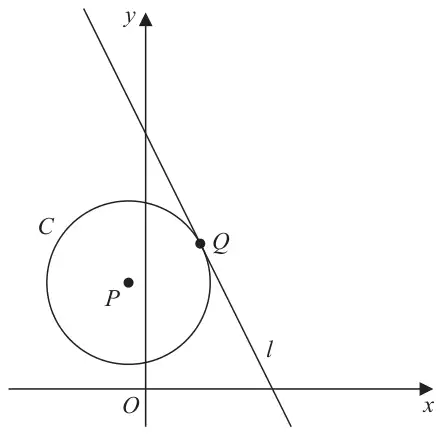
Figure 4 shows a sketch of the circle \(C\)
- the point \(P\,(-1,\ k + 8)\) is the centre of \(C\)
- the point \(Q\,(3,\ k^2 - 2k)\) lies on \(C\)
- \(k\) is a positive constant
- the line \(l\) is the tangent to \(C\) at \(Q\)
Given that the gradient of \(l\) is \(-2\)
| Scheme | Marks | AO |
|---|---|---|
| tangent \(= -2 \to\) normal \(= \dfrac{1}{2}\) | B1 | 2.2a |
| \(\dfrac{k^2 - 2k - k - 8}{3 - -1}\) | M1 | 1.1b |
| \(\dfrac{1}{2} = \dfrac{k^2 - 2k - k - 8}{3 - -1} \Rightarrow \dfrac{1}{2} = \dfrac{k^2}{4} - \dfrac{2k}{4} - \dfrac{k}{4} - 2\) | dM1 | 1.1b |
| \(\Rightarrow k^2 - 3k - 10 = 0\ *\) | A1* | 2.1 |
| (4) |
Notes
Attempts to implicitly differentiate the equation of the circle please send to review
B1: Deduces that the gradient between \(P\) and \(Q\) is \(\dfrac{1}{2}\). Condone this mark to be scored for sight of \(\dfrac{1}{2}\) o.e which may be on the diagram / by the question. May be implied by further work or seen in an equation.
Look out for e.g. \(\dfrac{-(3 - -1)}{k^2 - 2k - k - 8} = -2\) o.e. (negative reciprocal of the gradient \(PQ\) set equal to \(-2\)) which implies this mark.
M1: Attempts to find an expression for the gradient of \(PQ\) in terms of \(k\) (may be implied)
Score for the expression which may be seen in their working. Condone one sign slip in their expression. May be seen in \((y_2 - y_1) = m(x_2 - x_1)\) which does not need to be rearranged.
dM1: Sets their gradient of \(PQ\) equal to \(\dfrac{1}{2}\) (or the negative reciprocal of the gradient \(PQ\) set equal to \(-2\)) and proceeds to a quadratic so that the fraction for the gradient has been split up into separate terms.
e.g. \(k^2 - 2k - k - 8 = 2\)
Terms do not need to be collected for this mark and they do not all need to be on the same side of the equation. Coefficients do not need to be integers.
Condone slips in their rearrangement.
It is dependent on the first method mark.
If using \((y_2 - y_1) = m(x_2 - x_1)\) the mark would be scored substituting \(m = \dfrac{1}{2}\)
A1*: Achieves given answer with no errors seen. Must see = 0. They must have achieved a quadratic which is not the given answer before proceeding to the given answer.
Alt (a) forming/using linear equations with the coordinates of \(P\) and \(Q\)
B1: As above in the main scheme / notes
M1: Uses one pair of coordinates to form the equation of a straight line with a gradient of \(\dfrac{1}{2}\)
e.g. \(k^2 - 2k = \dfrac{3}{2} + c\) or \(k + 8 = -\dfrac{1}{2} + c\) (Condone one sign slip)
e.g. \(y - k - 8 = \dfrac{1}{2}(x + 1)\)
May use the coordinates for \(Q\) to form the equation of a straight line with a gradient of \(-2\)
dM1: Uses both pairs of coordinates and proceeds via a correct method to an equation in \(k\) only
e.g. \(k + 8 = -\dfrac{1}{2} + c \Rightarrow c = k + 8.5\) \(k^2 - 2k = \dfrac{3}{2} + c \Rightarrow k^2 - 2k = \dfrac{3}{2} + \text{``}k + 8.5\text{''}\)
Condone slips in their rearrangement.
You will need to look carefully at how they use the coordinates and equations.
It is dependent on the first method mark.
A1*: As above in the main scheme / notes
| Scheme | Marks | AO |
|---|---|---|
| \(k = 5\) | B1 | 2.3 |
| \(y\) coordinate of \(P\) is 13 | B1ft | 1.1b |
| Attempts \(PQ\ \left(= \sqrt{(3 - -1)^2 + (\text{``}25 - 15 - 8\text{''})^2}\right)\) (or \(PQ^2\)) | M1 | 3.1a |
| \((x + 1)^2 + (y - 13)^2 = 20\) | A1 | 1.1b |
| (4) | ||
| (8 marks) |
Notes
B1: Deduces that \(k\) is 5 only. May be seen by the question or in (a) which is fine but if both roots are found then 5 must be selected/used in further work or the negative root is rejected. May be implied by the \(y\) coordinate of \(P\)
Note that B0B1ftM1A0 is possible
B1ft: \(y\) coordinate of \(P\) is 13 Check on the diagram or may be implied by further work such as in the equation of the circle. If there is a contradiction between the diagram and the main body of the work then the main body of the work takes precedence.
Follow through on their positive value of \(k\) (add 8 to their value for \(k\)). Ignore if they find a value for \(P\) using their negative value of \(k\) as well
M1: Finds the distance \(PQ\) (or \(PQ^2\)) using their \(y\) coordinates from their chosen value of \(k\) (which may be negative). The value of \(k\) must be consistently used to find \(P\) and \(Q\).
If they find the distance \(PQ\) twice (using each value of \(k\) to find coordinates of \(P\) and \(Q\)) then condone this mark to be scored.
The expression is sufficient, but they must be attempting \(\sqrt{(3 - -1)^2 + (y_2 - y_1)^2}\) o.e. (or \((3 - -1)^2 + (y_2 - y_1)^2\) o.e). May be implied by sight of 20 or \(\sqrt{20}\)
A1: \((x + 1)^2 + (y - 13)^2 = 20\) only or equivalent e.g. \(x^2 + y^2 + 2x - 26y + 150 = 0\)