June 2024 Paper 1 Q4
4.
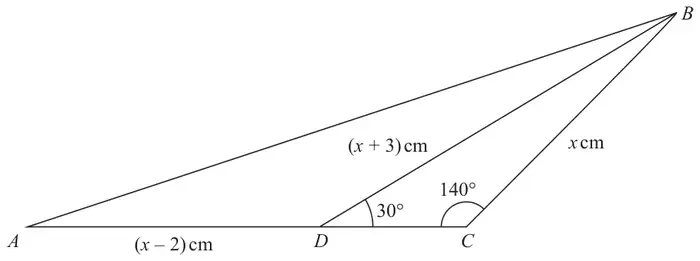
Figure 1 shows a sketch of triangle \(ABD\) and triangle \(BCD\)
Given that
- \(ADC\) is a straight line
- \(BD = (x + 3)\ \text{cm}\)
- \(BC = x\ \text{cm}\)
- angle \(BDC = 30^\circ\)
- angle \(BCD = 140^\circ\)
Given also that \(AD = (x - 2)\ \text{cm}\)
| Scheme | Marks | AO |
|---|---|---|
| \(\dfrac{x}{\sin 30^\circ} = \dfrac{x + 3}{\sin 140^\circ}\) | M1 | 1.1b |
| \(2x\sin 140 - x = 3\) | dM1 | 3.1a |
| \(x = 10.5\ *\) | A1* | 1.1b |
| (3) |
Notes
Do not allow verification attempts using \(x = 10.5\) by substituting into formulae
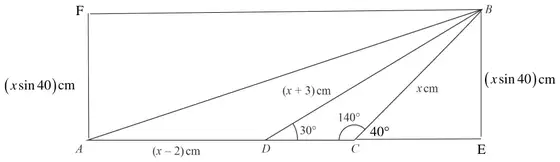
M1: Recognises the need to apply the sine rule and attempts to use it with the sides in the correct positions to form an equation in \(x\). Alternatively, uses trigonometric ratios twice to form an equation in \(x\)
e.g. \(BE = x\sin 40^\circ \Rightarrow \sin 30^\circ = \dfrac{x\sin 40^\circ}{x + 3}\) or e.g. \(AF = x\sin 40^\circ \Rightarrow \cos 60^\circ = \dfrac{x\sin 40^\circ}{x + 3}\)
May also see an attempt at Pythagoras’ Theorem:
\(BD^2 = BE^2 + DE^2 \Rightarrow (x + 3)^2 = \big((x + 3)\cos 30^\circ\big)^2 + (x\sin 40^\circ)^2\)
dM1: Attempts to rearrange the equation by collecting terms in \(x\) on one side of the equation and non \(x\) terms on the other. It is dependent on the previous method mark. Condone sign slips only in their rearrangement but allow miscopying/arithmetical slips when rounding. Do not allow this mark to be scored for proceeding directly to a numerical value for \(x\).
In the attempt using Pythagoras’ Theorem, look for an attempt to multiply out and rearrange to form a three-term quadratic.
A1*: Achieves 10.5 with sufficient working shown. Condone invisible brackets to be recovered. They must have achieved either a correct expression for \(x\) or \(x(2\sin 140^\circ - 1) = 3\) o.e. before stating 10.5 or better. It is acceptable to use rounded decimals for trigonometric values provided they are correct to at least 3sf. e.g. \(\sin 140^\circ = 0.64278\ldots\)
e.g. \(2x = \dfrac{x + 3}{\sin 140^\circ} \Rightarrow x = \dfrac{1.5}{\sin 40^\circ - 0.5} = 10.5\) scores M1dM1A1* (allow 0.5 in their initial equation for sin30 and allow interchanging of equivalent angles such as sin140 and sin40)
e.g. \(x\sin 140 = (x + 3)\sin 30^\circ \Rightarrow x = \dfrac{3\sin 30^\circ}{0.643 - \sin 30^\circ} = 10.5\) scores M1dM1A1*
e.g. \(\dfrac{x}{\sin 30^\circ} = \dfrac{x + 3}{\sin 140^\circ} \Rightarrow x\sin 140^\circ = (x + 3)\sin 30^\circ \Rightarrow x = 10.505\ldots\) is M1dM0A0* (insufficient working shown as they do not reach an expression for \(x\) or \(x(2\sin 140^\circ - 1) = 3\) o.e.)
In the method using Pythagoras’ Theorem usual rules apply for solving a quadratic but it cannot be awarded for proceeding to the answer via a calculator (e.g. must see use of the quadratic formula or completing the square).
| Scheme | Marks | AO |
|---|---|---|
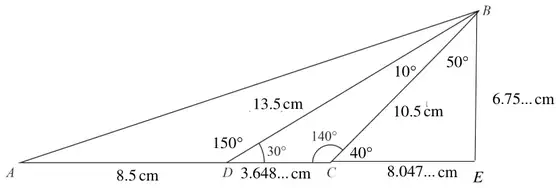
| \(AB^2 = 8.5^2 + 13.5^2 - 2 \times 8.5 \times 13.5 \times \cos\text{``}150\text{''}\) \(\Rightarrow AB = \ldots\) | M1 | 3.1a |
| \(AB =\) awrt 21.3 (cm) | A1 | 1.1b |
| (2) | ||
| (5 marks) |
Notes
M1: Applies the cosine rule correctly using \(150^\circ\) (or \(180^\circ - 30^\circ\) seen if incorrect) for angle \(ADB\) with the correct numerical lengths by attempting to substitute in \(x = 10.5\) or better and proceeds to obtain a value for \(AB\). Look for other methods such as finding lengths \(DC\) and \(CE\) followed by using trigonometry or Pythagoras’ Theorem on triangle \(ABE\). (see below)
A1: awrt 21.3 (cm) Units not required but if they are given they must be correct.
(Using full calculator display 21.29959497/using \(x = 10.5\) gives 21.28…)
Alt (b)
Note that there are various longer methods to finding \(AB\). General principles of marking alternative methods:
M1: A complete attempt to find a value for \(AB\), but condone slips. The angles and lengths in formulae should be in the correct positions, but allow slips when rearranging or calculating values.
e.g. \(BE = 6.75\ldots,\ AE = 8.5 + 3.648\ldots + 8.047\ldots = 20\ldots \Rightarrow AB = \sqrt{6.75\ldots^2 + 20\ldots^2} = \ldots\)
A1: awrt 21.3 (cm) Units not required but if they are given they must be correct.
(Using full calculator display 21.29959497/using \(x = 10.5\) gives 21.28…)