
Higher June 2024 Unit 1 Q9
9. A kite and an isosceles triangle are shown below.
They are not drawn to the same scale.
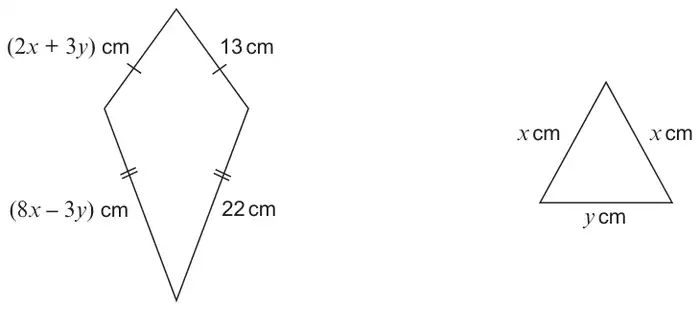
Diagrams not drawn to scale
Using the information shown on the kite, calculate the perimeter of the isosceles triangle.
Do not use a trial and improvement method.
You must show all your working. [5]
Perimeter of the isosceles triangle = …………………… cm
| Scheme | Marks | Comments |
|---|---|---|
| Sight of \(2x + 3y = 13\) AND \(8x - 3y = 22\) | B1 | Award B1 for sight of \((2x + 3y) + (8x - 3y) = 13 + 22\). May be implied in later working. |
| Method to eliminate one variable e.g. (equal coefficients AND) appropriate intention to add or subtract or use a method of substitution. | M1 | FT ‘their equations’ if of equivalent difficulty. If equating coefficients, allow one error in one term (not the term with equal coefficients). Sight of \(10x = 35\) implies B1M1. |
| First variable found \(x = 3{\cdot}5\) or \(y = 2\) or equivalent | A1 | CAO. Award A1 for \(2x = 7\). |
| Second variable found | A1 | FT substitution of their ‘1st variable’ if M1 gained. Accept an answer rounded, truncated or as an improper fraction (if not whole number) on FT, provided > 0. |
| (Perimeter of triangle = 3·5 + 3·5 + 2 =) 9 (cm) | B1 | FT ‘their derived \(x\) and \(y\)’, provided an algebraic method is used and both > 0. If the first B0 or B1 awarded, then award an additional SC1 for one of the following:
|