
PK 2019 Q24
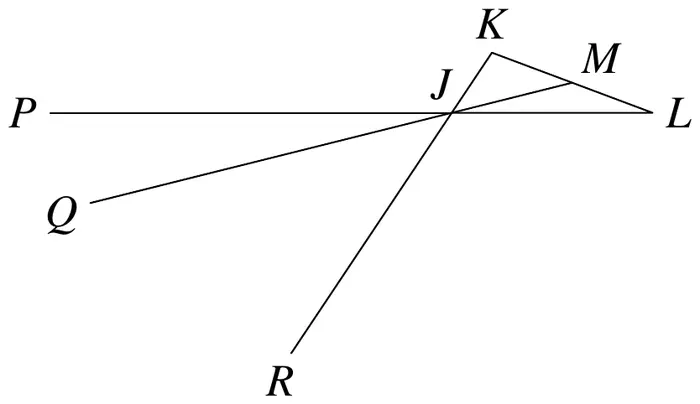
24. The diagram shows triangle \(JKL\) of area \(S\). The point \(M\) is the midpoint of \(KL\). The points \(P\), \(Q\), \(R\) lie on the extended lines \(LJ\), \(MJ\), \(KJ\), respectively, such that \(JP = 2 \times JL\), \(JQ = 3 \times JM\) and \(JR = 4 \times JK\).
What is the area of triangle \(PQR\)?
- A \(S\)
- B \(2S\)
- C \(3S\)
- D \(\tfrac{1}{2}S\)
- E \(\tfrac{1}{3}S\)
Pink Kangaroo 2019, Question 24. © UK Mathematics Trust. Original paper on ukmt.org.uk
Answer: A \(S\)
Let \(u\) be the area of triangle \(JLM\), and \(v\) be the area of triangle \(JMK\). Since \(M\) is the midpoint of \(KL\), the triangle \(JLM\) has half the area of the triangle \(JLK\), so \(u = v = \tfrac{1}{2}S\).
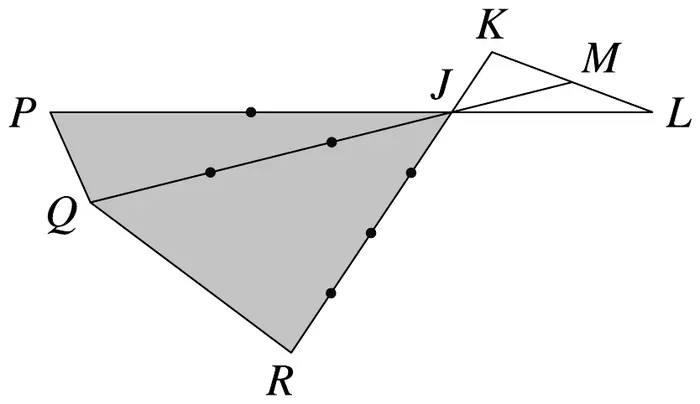
Note that \(\angle QJR = \angle KJM\), \(JR = 4 \times JK\) and \(JQ = 3 \times JM\). Hence, using the formula “Area of a triangle \(= \tfrac{1}{2}ab\sin C\)”, we see that the area of triangle \(JQR = 3 \times 4 \times v = 6S\).
Similarly the area of triangle \(PJQ = 2 \times 3 \times u = 6u = 3S\) and the area of triangle \(JPR = 2 \times 4 \times S = 8S\). Hence the area of triangle \(PQR = 6S + 3S - 8S = S\).
Solution © UK Mathematics Trust, from the PK 2019 solutions.