
Cayley 2019 Q6
6. A chessboard is formed from an \(8 \times 8\) grid of alternating black and white squares, as shown. The side of each small square is 1 cm.
What is the largest possible radius of a circle that can be drawn on the board in such a way that the circumference is entirely on white squares or corners?
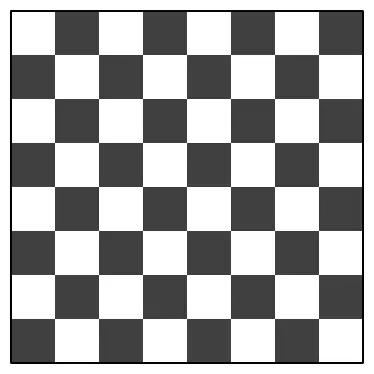
Cayley Olympiad 2019, Question 6. © UK Mathematics Trust. Original paper on ukmt.org.uk
Answer: \(\frac{1}{2}\sqrt{10}\) cm
To go from one white square to another, it is necessary to pass through a corner.
But it is not possible for a circle to pass through the point where two white squares meet (such as \(Y\) in the diagram alongside) and both the diagonally opposite corners of this point (\(X\) and \(Z\)), since these points form a straight line and not an arc of a circle.
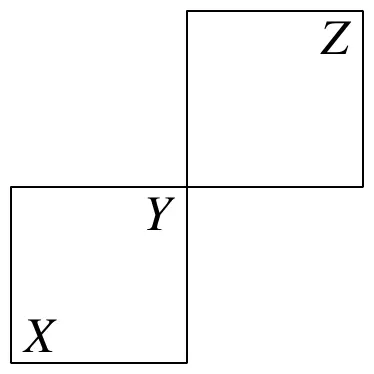
Is it possible for a circle to pass through exactly one of \(X\) and \(Z\), for every choice of \(Y\) on the circle? In other words, the circle is alternately “close” to a diagonal and an edge of white squares.
The diagram alongside shows one such circle, whose centre is as shown. The circle has diameter \(\sqrt{1^2 + 3^2}\), from Pythagoras’ theorem.
A circle passing through \(Y\) and neither \(X\) nor \(Z\), for every point \(Y\) on the circle, such as the dashed circle in the diagram alongside, has a smaller radius.
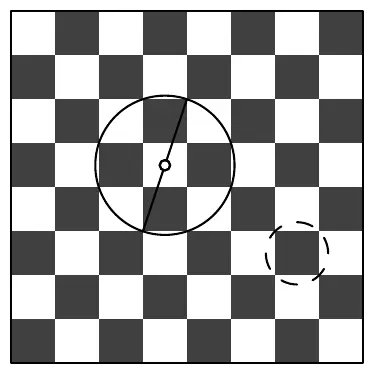
Therefore the largest possible radius of the circle is \(\frac{1}{2}\sqrt{10}\).
Solution © UK Mathematics Trust, from the Cayley Olympiad 2019 solutions.