
Cayley 2015 Q5
5. The diagram shows a right-angled triangle and three circles.
Each side of the triangle is a diameter of one of the circles.
The shaded region \(R\) is the region inside the two smaller circles but outside the largest circle.
Prove that the area of \(R\) is equal to the area of the triangle.
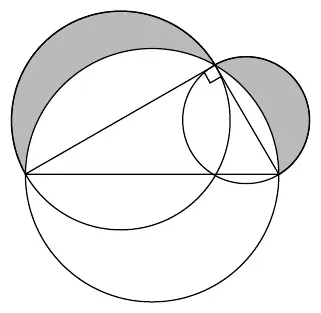
Cayley Olympiad 2015, Question 5. © UK Mathematics Trust. Original paper on ukmt.org.uk
Let \(T\) be the area of the triangle, let \(S_1\) be the area of the semicircle whose diameter is the hypotenuse, and let \(S_2\) and \(S_3\) be the areas of the two semicircles with the shorter sides of the triangle as diameters.
We can view the region in the figure above the hypotenuse in two different ways: either as a semicircle with diameter the hypotenuse plus the shaded region \(R\), or as the triangle plus the two smaller semicircles. This gives us the equation
Let the hypotenuse of the triangle have length \(c\) and let the shorter sides have lengths \(a\) and \(b\). Then the semicircles on those sides have radii \(\frac{1}{2}c\), \(\frac{1}{2}a\) and \(\frac{1}{2}b\) respectively. Hence the areas of the semicircles are \(S_1 = \frac{1}{8}\pi c^2\), \(S_2 = \frac{1}{8}\pi a^2\) and \(S_3 = \frac{1}{8}\pi b^2\) respectively. But \(a^2 + b^2 = c^2\) by Pythagoras' Theorem, so that we have
Subtracting equation (2) from equation (1) gives us area of \(R = T\), which is what we needed.
Solution © UK Mathematics Trust, from the Cayley Olympiad 2015 solutions.