
May 2023 Paper 2 Q3
3. Matrix \(A\) is defined by \(A=\begin{pmatrix}2&2x&4\\x&-1&0\\1&0&-2\end{pmatrix}\), where \(x\in\mathbb{R}\).
(a) Find a simplified expression for the determinant of \(A\). [2]
(b) Hence, determine whether \(A^{-1}\) exists for all values of \(x\). [1]
| Mark | Generic scheme | Illustrative scheme |
|---|---|---|
| •1 | begin to find determinant | eg \(2\begin{vmatrix}-1&0\\0&-2\end{vmatrix}-2x\begin{vmatrix}x&0\\1&-2\end{vmatrix}+4\begin{vmatrix}x&-1\\1&0\end{vmatrix}\) |
| •2 | simplify 1 | \(4x^2+8\) |
| (2) |
Notes:
- Do not award •2 where a candidate incorrectly simplifies \(4x^2+8\).
Commonly Observed Response:
Rule of Sarrus
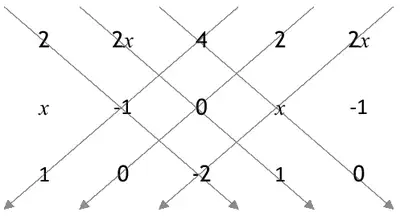 | award •1 |
| \(4x^2+8\) | award •2 |
| Mark | Generic scheme | Illustrative scheme |
|---|---|---|
| •3 | state conclusion 1,2,3,4 | eg \(4x^2+8\neq0\) \(A^{-1}\) always exists |
| (1) |
Notes:
- Accept \(4x^2+8>0\).
- Do not withhold •3 for omission of “always”.
- Accept ‘yes’ as conclusion after \(4x^2+8\neq0\).
- Where the answer contains incorrect information (before, between or after correct information), •3 is not available.
Commonly Observed Responses:
COR A – Candidate produces a quadratic expression which would have a negative discriminant
| \(4x^2+2x+8\neq0\), so \(A^{-1}\) (always) exists | award •3 |
COR B
| \(4x^2\neq0\) \(x\neq0\), so \(A^{-1}\) does not always exist | award •3 |
COR C
| \(4x^2+8=0\) \(x=(\pm)\sqrt{-2}\), so \(A^{-1}\) (always) exists | award •3 |
COR D
| \(4x^2+8=0\) \(x=(\pm)\sqrt{-2}\), so \(A^{-1}\) (always) exists except when \(x=(\pm)\sqrt{-2}\) | do not award •3 |
COR E
| \(4x^2+8=0\) \(x=(\pm)\sqrt{2}i\), so \(A^{-1}\) does not exist for \(x=(\pm)\sqrt{2}i\) | do not award •3 |