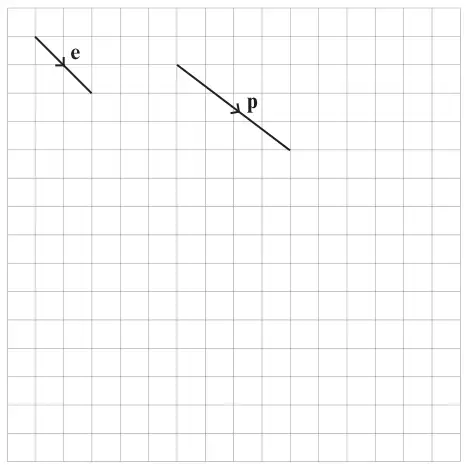
(a)The grid shows the vector \(\mathbf{e} = \begin{pmatrix} 2 \\ -2 \end{pmatrix}\) and the vector \(\mathbf{p}\).
The vector \(\mathbf{q} = \begin{pmatrix} -0{\cdot}5 \\ -2{\cdot}5 \end{pmatrix}\).
Draw a diagram on the grid above to represent \(\mathbf{p} + 2\mathbf{q}\). [2]
(b)
Diagram not drawn to scale
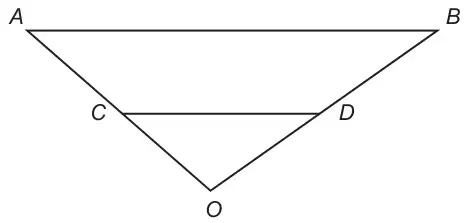
\(\mathbf{OA} = 3\mathbf{a}\) and \(\mathbf{OB} = 6\mathbf{b}\). The sides of triangles OAB and OCD are in the ratio 3 : 1.
By writing \(\mathbf{AB}\) and \(\mathbf{CD}\) in terms of \(\mathbf{a}\) and \(\mathbf{b}\), decide whether CD is parallel to AB.
Parallel □ Not Parallel □
Show how you decide. [3]
Mark scheme (a)
Scheme
Marks
Comments
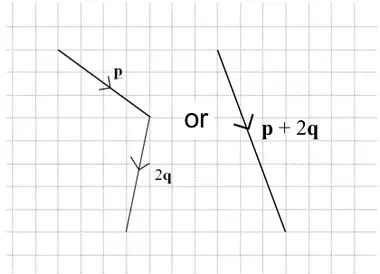
Correct completion of diagram e.g.
B2
B1 for the vector \(\begin{pmatrix} 3 \\ -8 \end{pmatrix}\) seen or \(\begin{matrix} 3 \\ -8 \end{matrix}\) seen or for a line representing \(\begin{pmatrix} 3 \\ -8 \end{pmatrix}\) without an arrow or for an arrow with only one component correct; applies to 2q in the left-hand diagram or the single vector in the right-hand diagram
allow complete diagram redrawn; may be unlabelled for B2 or B1, provided unambiguous; allow arrow at end of vector; allow good freehand
Mark scheme (b)
Scheme
Marks
Comments
\((\mathbf{AB} =)\ 6\mathbf{b} - 3\mathbf{a}\)
B1
may be on diagram; must be seen
\((\mathbf{CD} =)\ 2\mathbf{b} - \mathbf{a}\)
B1
may be on diagram; must be seen
Parallel indicated and e.g. \(6\mathbf{b} - 3\mathbf{a} = 3(2\mathbf{b} - \mathbf{a})\), (one is a scalar multiple of the other)
B1
dependent on all previous marks awarded Allow e.g. Parallel indicated and ‘They are multiples.’
We'd like to use Google Analytics cookies to count visits and see which pages help most. They're optional, and the site works exactly the same either way. Privacy policy