
Higher June 2024 Paper 1 Q23
23. The vectors OP, OQ and OR are shown in the diagram.
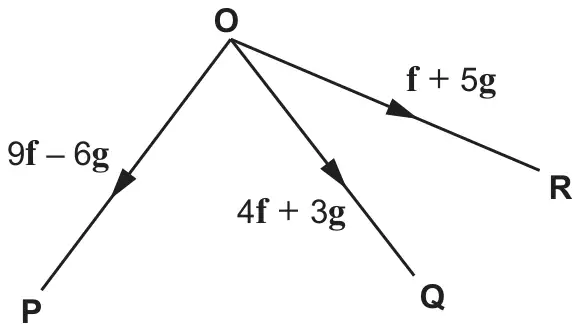
Diagram not drawn to scale
(a)
(i) RQ = kOP.
Find the value of k.
You must show all your working. [3]
(ii) Write down two facts about the lines OP and RQ. [2]
(b) O is the midpoint of the line PX.
Find PX in the form \(m\mathbf{f} + n\mathbf{g}\) where \(m\) and \(n\) are integers. [2]
| Scheme | Marks | Comments |
|---|---|---|
| (a)(i) \((\mathbf{RQ} =)\ {-}(\mathbf{f} + 5\mathbf{g}) + (4\mathbf{f} + 3\mathbf{g})\) | M1 | |
| \(3\mathbf{f} - 2\mathbf{g}\) | A1 | |
| \(k = 1/3\) | A1 | Unsupported \((k =)\ 1/3\) is awarded no marks |
| (a)(ii) RQ and OP are parallel | E1 | Allow the use of vector notation Do not allow ‘they both go in same direction’ |
| OP is 3 times the length of RQ or RQ is 1/3 of the length of OP | E1 | STRICT FT for ‘their k’ from (i) Do not accept OP = 3xRQ OR RQ = \(\frac{1}{3}\)xOP |
| Scheme | Marks | Comments |
|---|---|---|
| \((\mathbf{PX} =)\ {-18}\mathbf{f} + 12\mathbf{g}\) | B2 | Allow B2 for \(m = -18\) and \(n = 12\) B1 for \((\mathbf{PX} =)\ 2(-9\mathbf{f} + 6\mathbf{g})\) or \(-2(9\mathbf{f} - 6\mathbf{g})\) If no marks award SC1 for \((\mathbf{PX} =)\ 18\mathbf{f} - 12\mathbf{g}\) or \(m = 18\) and \(n = -12\) |
| (7) |