
Higher June 2019 Paper 1 Q22
22.
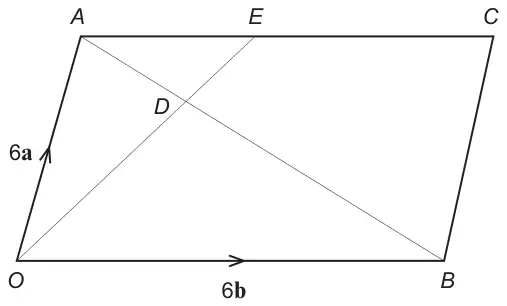
Diagram not drawn to scale
The diagram shows a parallelogram, OACB, and the vectors \(\mathbf{OA}\) and \(\mathbf{OB}\).
E lies on AC.
D is the point of intersection of OE and AB so that \(\mathbf{AD} = \dfrac13\mathbf{AB}\).
(a) Complete this proof to show that \(\mathbf{OE} = 6\mathbf{a} + 3\mathbf{b}\). [4]
Proof:
\(\mathbf{OE} = \mathbf{OA} + \mathbf{AE} = 6\mathbf{a} + k\mathbf{b}\) for some positive scalar \(k\)
\(\mathbf{OE} = n\mathbf{OD}\), for some positive scalar \(n\)
\(\mathbf{OD} =\) ……………
Proof:
\(\mathbf{OE} = \mathbf{OA} + \mathbf{AE} = 6\mathbf{a} + k\mathbf{b}\) for some positive scalar \(k\)
\(\mathbf{OE} = n\mathbf{OD}\), for some positive scalar \(n\)
\(\mathbf{OD} =\) ……………
(b) What does the proof in part (a) also tell you about the point E? [1]
| Scheme | Marks | Comments |
|---|---|---|
| Correct vector route for \(\mathbf{OD}\) e.g. \(\mathbf{OA} + \dfrac13\mathbf{AB}\) | B1 | |
| \(\mathbf{OD} = 4\mathbf{a} + 2\mathbf{b}\) | B1 | Accept unsimplified e.g. \(6\mathbf{a} + \dfrac13(6\mathbf{b} - 6\mathbf{a})\); implies first B1 |
| Compares \(\mathbf{OE} = 4n\mathbf{a} + 2n\mathbf{b}\) and \(\mathbf{OE} = 6\mathbf{a} + k\mathbf{b}\) to find \(n = 1.5\) | B1 | |
| Finds \((2n =)\ k = 3\) or shows that \(1.5(4\mathbf{a} + 2\mathbf{b}) = 6\mathbf{a} + 3\mathbf{b}\) | B1 | NB Answer is given so only award this mark following a complete argument |
| Scheme | Marks | Comments |
|---|---|---|
| Valid deduction e.g. ‘E is the mid-point of AC’ | E1 | |
| (5) |