
M4 June 2014 (R) Q6
6.
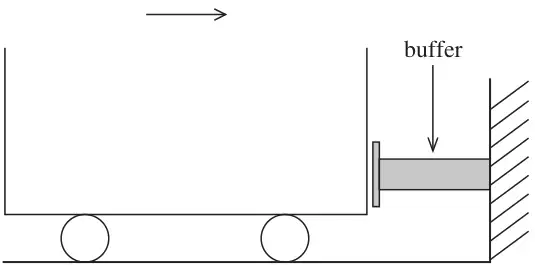
A railway truck of mass \(M\) approaches the end of a straight horizontal track and strikes a buffer. The buffer is parallel to the track, as shown in Figure 2. The buffer is modelled as a light horizontal spring \(PQ\), which is fixed at the end \(P\). The spring has a natural length \(a\) and modulus of elasticity \(Mn^2a\), where \(n\) is a postive constant. At time \(t = 0\), the spring has length \(a\) and the truck strikes the end \(Q\) with speed \(U\). A resistive force whose magnitude is \(Mkv\), where \(v\) is the speed of the truck at time \(t\), and \(k\) is a positive constant, also opposes the motion of the truck. At time \(t\), the truck is in contact with the buffer and the compression of the buffer is \(x\).
It is given that \(k = \dfrac{5n}{2}\)
| Scheme | Marks |
|---|---|
| \(-Mkv - T = M\ddot{x}\) | M1 A1 |
| \(-Mk\dot{x} - \dfrac{Mn^2ax}{a} = M\ddot{x}\) In terms of \(x\) | M1 |
| \(\ddot{x} + k\dot{x} + n^2x = 0\) *Answer Given* | A1 |
| (4) |
| Scheme | Marks |
|---|---|
| Aux equn: \(p^2 + \dfrac{5n}{2}p + n^2 = 0\) | M1 |
| \(p = -\dfrac{n}{2}\) or \(-2n\) | |
| \(x = A\mathrm{e}^{-\frac{n}{2}t} + B\mathrm{e}^{-2nt}\) General solution | A1 |
| \(t = 0,\ x = 0 \Rightarrow 0 = A + B\) | B1 |
| \(\dot{x} = -\dfrac{nA}{2}\mathrm{e}^{-\frac{n}{2}t} - 2nB\mathrm{e}^{-2nt}\) Differentiate | M1 |
| \(t = 0,\ \dot{x} = U \Rightarrow U = -\dfrac{nA}{2} - 2nB\) | A1 |
| \(\Rightarrow -\dfrac{2U}{n} = A + 4B\) | |
| \(A = \dfrac{2U}{3n};\ B = -\dfrac{2U}{3n}\) Solve for \(A,\ B\) | M1 |
| \(x = \dfrac{2U}{3n}\mathrm{e}^{-\frac{n}{2}t} - \dfrac{2U}{3n}\mathrm{e}^{-2nt}\) | A1 |
| (7) |
Notes
(Corrected from the printed mark scheme: the initial condition is printed as \(t = 0,\ x = U\); it is the speed, \(\dot{x} = U\).)
| Scheme | Marks |
|---|---|
| \(\dot{x} = \dfrac{U}{3}\left(4\mathrm{e}^{-2nt} - \mathrm{e}^{-\frac{n}{2}t}\right)\) | M1 |
| \(\dot{x} = 0 \Rightarrow 4\mathrm{e}^{-2nt} - \mathrm{e}^{-\frac{n}{2}t} = 0\) | M1 |
| \(\mathrm{e}^{\frac{3n}{2}t} = 4\) | A1 |
| \(x = \dfrac{2U}{3n}\left(2^{-\frac{2}{3}} - 2^{-\frac{8}{3}}\right) = \dfrac{U}{n}\left(2^{-\frac{5}{3}}\right) \qquad \left(0.31\dfrac{U}{n}\right)\) | M1 A1 |
| (5) | |
| (16 marks) |