
M4 June 2006 Q5
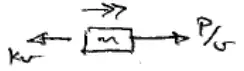
5. A train of mass \(m\) is moving along a straight horizontal railway line. A time \(t\), the train is moving with speed \(v\) and the resistance to motion has magnitude \(kv\), where \(k\) is a constant. The engine of the train is working at a constant rate \(P\).
(a) Show that, when \(v \gt 0\), \(\quad mv\dfrac{\mathrm{d}v}{\mathrm{d}t} + kv^2 = P\). (3)
When \(t = 0\), the speed of the train is \(\dfrac{1}{3}\sqrt{\left(\dfrac{P}{k}\right)}\).
(b) Find, in terms of \(m\) and \(k\), the time taken for the train to double its initial speed. (8)
| Scheme | Marks |
|---|---|
| \(\dfrac{P}{v}\) | B1 |
| \((\rightarrow)\colon\ \dfrac{P}{v} - kv = m\dfrac{dv}{dt}\) | M1 |
| \(\Rightarrow P = mv\dfrac{dv}{dt} + kv^2\ \ *\) | A1 |
| (3) |
Notes
The published mark scheme for this paper is handwritten.
| Scheme | Marks |
|---|---|
| \(\displaystyle\int_0^T dt = \int_u^{2u} \frac{mv\,dv}{P - kv^2}\qquad \left(u = \tfrac{1}{3}\sqrt{\tfrac{P}{k}}\right)\) | M1 A1 |
| \(\Rightarrow T = \dfrac{-m}{2k}\Big[\ln\left(P - kv^2\right)\Big]_u^{2u}\) | A2 |
| \(= \dfrac{m}{2k}\left\{\ln\left(P - \dfrac{k}{9}.\dfrac{P}{k}\right) - \ln\left(P - \dfrac{4k}{9}.\dfrac{P}{k}\right)\right\}\) | M1 A1 |
| \(= \dfrac{m}{2k}\left\{\ln\dfrac{8P}{9} - \ln\dfrac{5P}{9}\right\}\) | |
| \(= \dfrac{m}{2k}\ln\left(\dfrac{8P}{9} \times \dfrac{9}{5P}\right)\) | M1 |
| \(= \dfrac{m}{2k}\ln\dfrac{8}{5}\) | A1 |
| (8) | |
| (11 marks) |