
FP2 June 2013 Q6
6.
| Scheme | Marks |
|---|---|
| \(2x^2 + 6x - 5 = 5 - 2x\) | M1 |
| \(2x^2 + 8x - 10 = 0\) \(x^2 + 4x - 5 = 0\) | |
| \((x + 5)(x - 1) = 0\) or by formula | M1 |
| \(x = -5,\ x = 1\) | A1 |
| \(-2x^2 - 6x + 5 = 5 - 2x\) | M1 |
| \(2x^2 + 4x = 0\) | A1 |
| \(x = 0\quad x = -2\) | A1 |
| (6) |
Notes
NB: Marks for (a) can only be awarded for work shown in (a):
M1 for \(2x^2 + 6x - 5 = 5 - 2x\)
M1 for obtaining a 3 term quadratic and attempting to solve by factorising, formula or completing the square
A1 for \(x = -5,\ x = 1\)
M1 for considering the part of the quadratic that needs to be reflected ie for \(-2x^2 - 6x + 5 = 5 - 2x\) oe
A1 for a correct 2 term quadratic, terms in any order \(2x^2 + 4x = 0\) oe
A1 for \(x = 0\quad x = -2\)
NB: The question demands that algebra is used, so solutions which do not show how the roots have been obtained will score very few if any marks, depending on what is written on the page.
Alternative: Squaring both sides:
M1 Square both sides and simplify to a quartic expression
M1 Take out the common factor \(x\)
A1 \(x\), a correct linear factor and a correct quadratic factor
M1 \(x\) and 3 linear factors
A1 any two of the required values
A1 all 4 values correct
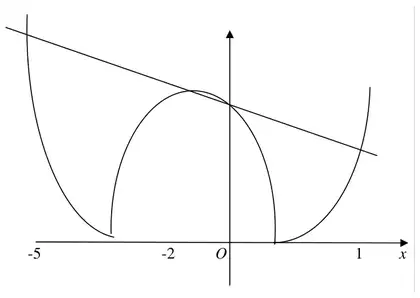
| Scheme | Marks |
|---|---|
| B1 line | |
| B1 quad curve | |
| B1ft (on \(x\)-coords from (a)) | |
| (3) |
Notes
B1 for a line drawn, with negative gradient, crossing the positive \(y\)-axis
B1 for the quadratic curve, with part reflected and the correct shape. It should cross the \(y\)-axis at the same point as the line and be pointed where it meets the \(x\)-axis (ie not U-shaped like a turning point)
B1ft for showing the \(x\) coordinates of the points where the line crosses the curve. They can be shown on the \(x\)-axis as in the MS (accept \(O\) for 0) or written alongside the points as long as it is clear the numbers are the \(x\) coordinates
The line should cross the curve at all the crossing points found and no others for this mark to be given.
| Scheme | Marks |
|---|---|
| \(x < -5,\quad -2 < x < 0,\quad x > 1\) | B1,B1,B1 |
| Special case: Deduct the last B mark earned1 if \(\leqslant\) or \(\geqslant\) used | |
| (3) | |
| (12 marks) |
Notes
NB: No follow through for these marks
B1 for any one of \(x < -5,\quad -2 < x < 0,\quad x > 1\) correct
B1 for a second one of these correct
B1 for the third one correct
Special case: if \(\leqslant\) or \(\geqslant\) is used, deduct the last B mark earned.