
D1 June 2018 Q7
7. A café sells two types of scone, plain and fruit.
The café manager knows that each week she should order
- at least 400 scones in total
- at most 350 fruit scones
In addition, for every 3 fruit scones ordered, at most 5 plain scones should be ordered.
Each plain scone costs £0.11 and is sold at a profit of £0.75
Each fruit scone costs £0.14 and is sold at a profit of £1
The manager has £77 to spend each week on scones. The manager wants to maximise her profit and it can be assumed that all scones ordered will be sold.
Let \(x\) represent the number of plain scones and let \(y\) represent the number of fruit scones that are sold.
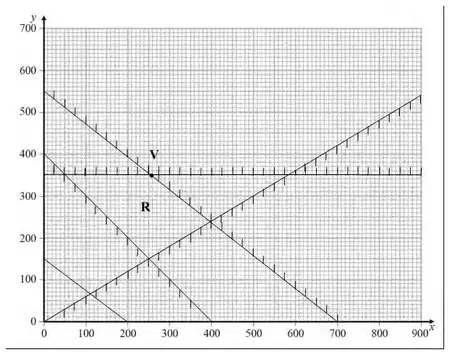
Hence determine the feasible region and label it R. (4)
| Scheme | Marks |
|---|---|
| Maximise \(0.75x + y\) | B1 |
| Subject to \(x + y \geqslant 400\) | B1 |
| \(y \leqslant 350\) | B1 |
| \(5y \geqslant 3x\) | M1 A1 |
| \(11x + 14y \leqslant 7700\) | B1 |
| (6) |
Notes
a1B1: Expression correct (or \(75x + 100y\)) together with ‘maximise’ or ‘max’ but not ‘maximum’ – isw if coefficients are subsequently simpified but either \(75x + 100y\) or \(0.75x + y\) must be seen at some point for this mark to be awarded. The ‘max’ must appear beside or suitably close to one of the correct two expressions
a2B1: CAO (\(x + y \geqslant 400\))
a3B1: CAO (\(y \leqslant 350\))
a1M1: \(5y \blacksquare 3x\) where \(\blacksquare\) is any inequality or equals. Accept \(3y \geqslant 5x\) for this mark. M0 if coefficients are not integers
a1A1: CAO (\(5y \geqslant 3x\))
a4B1: CAO (\(11x + 14y \leqslant 7700\))
| Scheme | Marks |
|---|---|
| B1 | |
| B1 | |
| B1 | |
| B1 | |
| (4) |
Notes
In (b), lines must be long enough to define the correct feasible region and pass through one small square of the points stated:
\(x + y = 400\) must pass within one small square of its intersection with the axes – (0, 400) and (400, 0)
\(11x + 14y = 7700\) must pass within one small square of its intersection with the axes – (0, 550) and (700, 0)
\(5y = 3x\) must pass within one small square of (0, 0) and if extended pass through (500, 300)
\(y = 350\) must pass within one small square of (0, 350) and if extended pass through (500, 350)
b1B1: Any two lines correctly drawn
b2B1: Any three lines correctly drawn
b3B1: All four lines correctly drawn
b4B1: Region, R, correctly labelled – dependent on scoring the first three marks in this part
| Scheme | Marks |
|---|---|
| Drawing an objective line accept reciprocal gradient | M1 |
| Correct objective line | A1 |
| V correctly labelled | A1 |
| (3) |
Notes
c1M1: Drawing their objective line (based on their answer to (a)) or its reciprocal – if their line on the graph is shorter than the length equivalent to that of the line from (0, 37.5) to (50, 0) then M0. Line must be correct to within one small square if extended from axis to axis. Their line must have a negative gradient
c1A1: Drawing the correct objective line – same condition that the line must be correct to within one small square if extended from axis to axis
c2A1: The correct V labelled or clearly identified on their graph – note that this mark is dependent on scoring at least B1B1B1B0 in (b) and the two previous marks in this part
| Scheme | Marks |
|---|---|
| \(\text{V}\left(\dfrac{2800}{11},\ 350\right)\) | M1 A1 |
| (2) |
Notes
d1M1: Must have scored at least B1B1B0B0 in (b) and candidates must have drawn an objective line (but note that it does not need to be correct but must have negative gradient). Must be solving one of the following three pairs of equations only: \(11x + 14y = 7700,\ y = 350\) or \(11x + 14y = 7700,\ 5y = 3x\) or \(5y = 3x,\ y = 350\). Must be a correct method to solve simultaneous equations and must arrive at \(x = \ldots\) and \(y = \ldots\) but allow slips/errors. This mark can also be awarded for the correct exact coordinates stated with no working provided B1B1B0B0 in (b) and an objective line drawn
d1A1: Correct exact coordinates of V either derived or stated (so no working required) as either \(\left(\dfrac{2800}{11},\ 350\right)\) or \(\left(254\dfrac{6}{11},\ 350\right)\). Note that this mark is dependent on B1B1B1B0 scored in (b) and a correct objective line
| Scheme | Marks |
|---|---|
| (The manager should buy) 254 plain (scones) and 350 fruit (scones) | B1 |
| Profit is (£) 540.50 | B1 |
| (2) | |
| (17 marks) |
Notes
e1B1: CAO in context – so not in terms of \(x\) and \(y\) only – dependent on B1B1B1B0 in (b) and a correct objective line
e2B1: CAO (allow 540.5) – dependent on B1B1B1B0 in (b) and a correct objective line – condone lack of units if given in £ (or 54050p – if given in pence, however, units must be given)