
D1 June 2017 Q1
1.
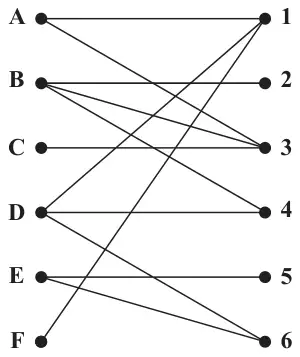
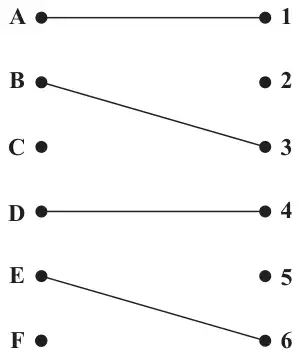
At a hotel, six guests, A, B, C, D, E and F, are to be allocated to six rooms, 1, 2, 3, 4, 5 and 6. Each room needs to be allocated to exactly one guest.
A bipartite graph showing their possible allocations is given in Figure 1. An initial matching is given in Figure 2.
Guest C now has room 5 added to his possible allocations.
| Scheme | Marks |
|---|---|
| (i) A bipartite graph consists of two sets of vertices X and Y | B1 |
| The edges only join vertices in X to vertices in Y, not vertices within a set | B1 |
| (ii) A path from an unmatched vertex in one set to an unmatched vertex in the other set which alternately uses arcs not in/in the matching | B1 B1 |
| (4) |
Notes
ai1B1: Two sets of vertices – must contain the three words in bold – accept nodes for vertices but not points or any other non-technical language
ai2B1: (Edges) must go from one (set) into the other – candidates must give an indication of going from one set to the other – however, they do not need to use the word ‘set’ for this mark. Candidates do not need to mention that edges should not join vertices within a set but if a candidate does imply that a bipartite graph can join vertices within a set then withold this mark (no isw). If a candidate only says that you cannot connect nodes from the same set then this is B0. As an absolute minimum accept a statement along the lines of: ‘must go from one to the other’ – note that for this mark technical language may be absent or incorrect.
aii3B1: unmatched to unmatched (vertices do not need to be explicitly mentioned for this mark but B0 if arcs implied)
aii4B1: (alternate) arcs not in/in (not vertices/nodes) – must mention arcs/edges (not lines) and an understanding of what ‘alternating’ means in this context
| Scheme | Marks |
|---|---|
| Alternating path: F – 1 = A – 3 = B – 4 = D – 6 = E – 5 | M1 |
| Change status: F = 1 – A = 3 – B = 4 – D = 6 – E = 5 | A1 |
| Improved matching: A = 3, B = 4, (C unmatched), D = 6, E = 5, F = 1 | A1 |
| (3) |
Notes
SC: APs FROM F TO 2 AND FROM C TO EITHER 2 OR 5 - SEE NOTESb1M1: An alternating path (e.g. letter 1st set – number 2nd set – letter 1st set – …) from F to 5 or vice-versa
b1A1: CAO – a correct path including change status either stated (only accept ‘change (of) status’ or ‘c.s’ but not, e.g.‘change state’) or shown (all symbols e.g. (… – … = … – …) interchanged (… = …. – … = …)) Chosen path clear
e.g.
- F * 1 = A * 3 = B * 4 = D * 6 = E * 5
F = 1 * A = 3 * B = 4 * D = 6 * E = 5 scores M1A1 (change status shown) - change status F – 1 = A – 3 = B – 4 = D – 6 = E – 5 scores M1A1 (change status stated)
- c.s. F – 1 = A – 3 = B – 4 = D – 6 = E – 5 scores M1A1 (change status stated)
- F – 1 = A – 3 = B – 4 = D – 6 = E – 5
c.s. F = 1 – A = 3 – B = 4 – D = 6 – E = 5 scores M1A1 (change status stated and shown) - F – 1 = A – 3 = B – 4 = D – 6 = E – 5
F = 1, A = 3, B = 4, … scores M1A0 (no change status stated or shown)
b2A1: CAO – improved matching - must follow from the correct stated path. Accept either stated or on a clear diagram (with five arcs only). Please check the top of the second page as many candidates will draw either the improved or complete matching on the nodes provided there
| Scheme | Marks |
|---|---|
| Alternating path: C – 5 = E – 6 = D – 4 = B – 2 | M1 |
| Change status: C = 5 – E = 6 – D = 4 – B = 2 | A1 |
| Complete matching: A = 3, B = 2, C = 5, D = 4, E = 6, F =1 | A1 |
| (3) | |
| (10 marks) |
Notes
c1M1: A second alternating path from C to 2 or vice-versa
c1A1: CAO – a correct path including change status stated or shown. Chosen path clear
c2A1: CAO (complete matching) must follow from two correct stated paths (so both previous M marks must have been awarded). Accept on a clear diagram (with six arcs only)
Special Cases for (b) and (c):Alternating path from F to 2Candidates who find an alternating path from F to 2 can score in (b)
M1 for an alternating path from F to 2 (or vice-versa),
A1 for the correct alternating path (F – 1 = A – 3 = B – 2) and change of status (stated or shown)
A1 for the correct improved matching of A = 3, B = 2, D = 4, E = 6, F = 1 from the correct stated path
In (c) the alternating path is simply C – 5 and therefore no marks in (c) – so an alternating path from F to 2 can score a maximum of three marks (of the six available) in (b) and (c)
Alternating path from either C to 2 or C to 5Candidates who find in (b) an alternating path from either C to 2 or C to 5 can score in (b)
M1 for an alternating path from either C to 2 or C to 5
A1 for either C – 3 = B – 2 or C – 3 = B – 4 = D – 6 = E – 5 together with the change of status (either stated or shown)
A0
In (c)
M1 for either F – 1 = A – 3 = C – 5 (following their path fom C to 2) or F – 1 = A – 3 = C – 5 = E – 6 = D – 4 = B – 2 (following their path from C to 5)
A0
A0
So both special cases can score a maximum of three marks (of the six available in (b) and (c))