
D1 June 2010 Q5
5.
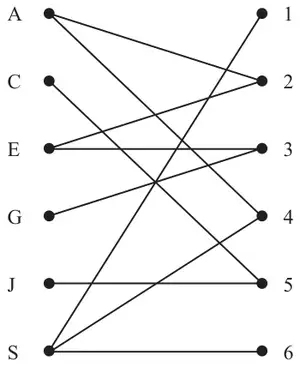
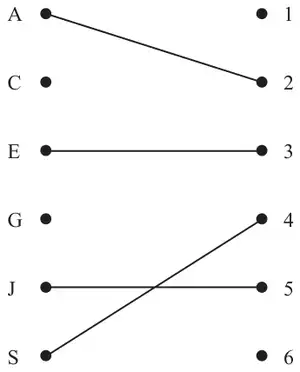
Figure 3 shows the possible allocations of six people, Amelia, Charlie, Ellie, Gemma, Jimmy and Saskia, to six tasks, 1, 2, 3, 4, 5 and 6.
Figure 4 shows an initial matching.
You must state the alternating path used and your improved matching. (3)
After training, Jimmy can be assigned to tasks 4 or 5 and Ellie to tasks 2, 3, 5 or 6.
| Scheme | Marks |
|---|---|
| e.g. G – 3 = E – 2 = A – 4 = S – 6 | M1 |
| Change status G = 3 – E = 2 – A = 4 – S = 6 | A1 |
| Improved matching A = 4 (C unmatched) E = 2 G = 3 J = 5 S = 6 | A1 |
| (3) |
Notes
1M1: Path from G to 6 or 1
1A1: CAO including change status ( stated or shown), chosen path clear.
2A1: CAO must ft from stated path, diagram ok
Alternative
(a) G – 3 = E – 2 = A – 4 = S – 1 c.s. G = 3 – E = 2 – A = 4 – S = 1
A = 4, (C unmatched), E = 2, G = 3, J = 5, S = 1
| Scheme | Marks |
|---|---|
| e.g. Both C and J can only be matched to 5 Both 1 and 6 can only be done by S | B2, 1, 0 |
| (2) |
Notes
1B1: Correct answer, may be imprecise or muddled (bod gets B1) all relevant nodes should be referred to and must be correct, but condone one (genuine) slip.
2B1: Good, clear, correct answer.
| Scheme | Marks |
|---|---|
| C – 5 = J – 4 = A – 2 = E – 6 = S – 1 | M1 |
| Change status C = 5 – J = 4 – A = 2 – E = 6 – S = 1 | A1 |
| Complete matching A = 2 C = 5 E = 6 G = 3 J = 4 S = 1 | A1 |
| (3) | |
| (8 marks) |
Notes
1M1: Path from C to 1 or 6 [whichever they didn’t use before.]
1A1: CAO including change status ( stated or shown), chosen path clear. (Don’t penalise change status twice.)
2A1: CAO must ft from stated path, diagram ok
Alternative
(c) C – 5 = J – 4 = A – 2 = E – 6 c.s. C = 5 – J = 4 – A = 2 – E = 6
A = 2, C = 5, E = 6, G = 3, J = 4, S = 1