
D1 June 2009 Q3
3.
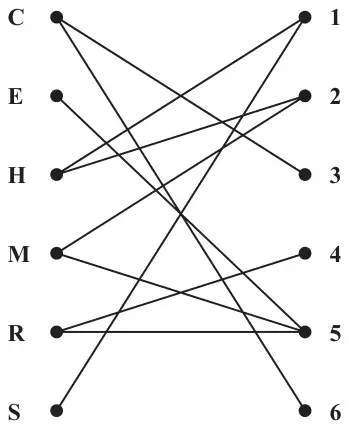
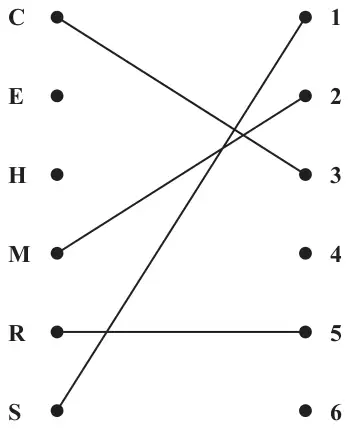
Figure 1 shows the possible allocations of six workers, Charlotte (C), Eleanor (E), Harry (H), Matt (M), Rachel (R) and Simon (S) to six tasks, 1, 2, 3, 4, 5 and 6.
Figure 2 shows an initial matching.
(a) List an alternating path, starting at H and ending at 4. Use your path to find an improved matching. List your improved matching. (3)
(b) Explain why it is not possible to find a complete matching. (1)
Simon (S) now has task 3 added to his possible allocation.
(c) Taking the improved matching found in (a) as the new initial matching, use the maximum matching algorithm to find a complete matching. List clearly the alternating path you use and your complete matching. (3)
| Scheme | Marks |
|---|---|
| H – 2 = M – 5 = R – 4 change status to give | M1 A1 |
| C = 3 (E unmatched) H = 2 M = 5 R = 4 S = 1 | A1 |
| (3) |
Notes
(a) 1M1: Path from H to 4
1A1: correct path and change status
2A1: CAO must follow from correct path.
| Scheme | Marks |
|---|---|
| e.g. C is the only person who can do 3 and the only person who can do 6 | B1 |
| (1) |
Notes
(b) 1B1: CAO or e.g reference to E 5 M 2 H 1 S
| Scheme | Marks |
|---|---|
| e.g. E – 5 = M – 2 = H – 1 = S – 3 = C – 6 change status to give | M1 A1 |
| C = 6 E = 5 H = 1 M = 2 R = 4 S = 3 | A1 |
| (3) | |
| (7 marks) |
Notes
(c) 1M1: Path from E to 6
1A1: CAO do not penalise lack of change status a second time.
2A1: CAO must follow from a correct path