
D1 January 2006 Q1
1.
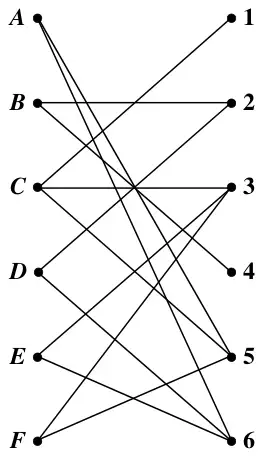
A taxi firm has six taxis \(A\), \(B\), \(C\), \(D\), \(E\) and \(F\), available for six journeys, 1, 2, 3, 4, 5 and 6, which are booked for 9 a.m. tomorrow.
The bipartite graph shown in Figure 1 shows the possible matchings.
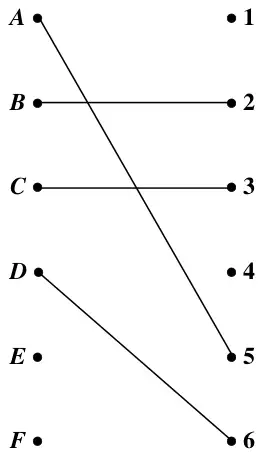
Initially \(A\), \(B\), \(C\) and \(D\) are matched to 5, 2, 3 and 6 respectively, as indicated in Figure 2.
(a) Explain why it is necessary to perform the maximum matching algorithm twice in order to try to obtain a complete matching. (1)
(b) Use the maximum matching algorithm twice to obtain a complete matching. List clearly the alternating paths you use. (6)
| Scheme | Marks |
|---|---|
| There are 2 unmatched vertices on each side – the algorithm only matches one on each side per iteration. | B1 |
| (1) |
| Scheme | Marks |
|---|---|
| e.g. \(E - 3 = C - 1\) c.s. \(E = 3 - C = 1\) | M1 A1 (2) |
| \(F - 5 = A - 6 = D - 2 = B - 4\) c.s. \(F = 5 - A = 6 - D = 2 - B = 4\) | M1 A1 (2) |
| \(A = 6\quad B = 4\quad C = 1\quad D = 2\quad E = 3\quad F = 5\) | M1 A1 (2) |
| (6) | |
| (7 marks) |
Notes
c.s. = change status. Each M1 depends on the previous M1.
(Corrected from the printed mark scheme: the second change of status is printed as \(F = 5 - A = 6 - D = 2 = B - 4\).)