
Higher November 2023 Paper 1 Q5
5 The diagram shows a shaded shape made from three identical semicircles, \(\boldsymbol{X}\), \(\boldsymbol{Y}\) and \(\boldsymbol{Z}\)
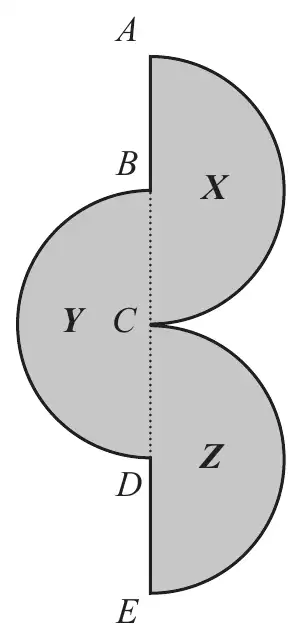
Diagram NOT accurately drawn
\(ABCDE\) is a straight line.
\(AC\) is the diameter of semicircle \(\boldsymbol{X}\) and \(B\) is the centre of semicircle \(\boldsymbol{X}\)
\(BD\) is the diameter of semicircle \(\boldsymbol{Y}\) and \(C\) is the centre of semicircle \(\boldsymbol{Y}\)
\(CE\) is the diameter of semicircle \(\boldsymbol{Z}\) and \(D\) is the centre of semicircle \(\boldsymbol{Z}\)
\(AC = BD = CE = 20\) cm
Work out the perimeter of the shaded shape.
Give your answer correct to the nearest whole number.
(3)
| Scheme | Marks |
|---|---|
| \(\pi \times 20\;(= 20\pi = 62.8(31...))\) oe or \(2 \times \pi \times (20 \div 2)\;(= 20\pi = 62.8(31...))\) oe or \(0.5 \times \pi \times 20\;(= 10\pi = 31.4(15...))\) oe or | M1 |
| 3 × (“62.8” ÷ 2) + 20 ÷ 2 + 20 ÷ 2 oe or 1.5 × (“62.8”) + 20 ÷ 2 + 20 ÷ 2 oe | M1 |
| Working not required, so correct answer scores full marks (unless from obvious incorrect working) Answer: 114 | A1 |
| (3) | |
| (3 marks) |
Notes
M1: (first) for use of \(\frac{1}{2}\pi d\) or \(\pi r\) or \(\pi d\) or \(2\pi r\) oe with \(d = 20\) or \(r = 20 \div 2\) (= 10)
M1: (second) for a complete method
A1: 114 – 115
SCB1 for awrt 471