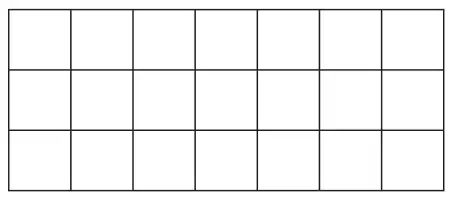
(b) Write \(\dfrac{23}{3}\) as a mixed number. (1)
(c) Find \(\dfrac{2}{5}\) of 60 cm. (2)
Claude says that \(\dfrac{1}{6}\) is exactly halfway between \(\dfrac{1}{4}\) and \(\dfrac{1}{8}\)
(d) Is Claude correct? You must give a reason for your answer. (2)
Mark scheme (a)
Scheme
Marks
9 squares shaded
B1
(1)
Mark scheme (b)
Scheme
Marks
\(7\dfrac{2}{3}\)
B1
(1)
Mark scheme (c)
Scheme
Marks
60 ÷ 5 or 12 or 2 × 60 or 120
M1
24
A1
(2)
Mark scheme (d)
Scheme
Marks
\(\dfrac{1}{4} = \dfrac{4}{16}\) and \(\dfrac{1}{8} = \dfrac{2}{16}\) oe or
\(\dfrac{1}{4} = \dfrac{6}{24}\) and \(\dfrac{1}{8} = \dfrac{3}{24}\) and \(\dfrac{1}{6} = \dfrac{4}{24}\) oe
M1
Correct conclusion based on correct figures
A1
(2)
(6 marks)
Notes
M1: or use of decimals for 0.25 and 0.125
A1: e.g. \(\dfrac{3}{16}\) is halfway between \(\dfrac{1}{4}\) and \(\dfrac{1}{8}\) \(\left(\dfrac{3}{16} \ne \dfrac{1}{6}\right)\) oe or using second method above, 4 is not halfway between 3 and 6 or 0.1875, 0.16666… and No