
A2 October 2021 Q3
3.
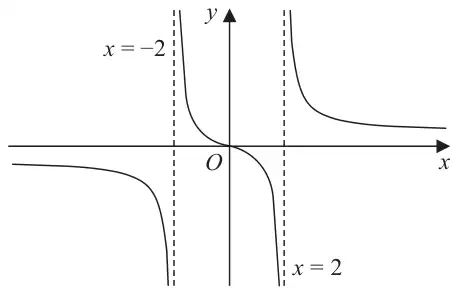
Figure 1 shows a sketch of the curve with equation \(y = \mathrm{f}(x)\) where
\[\mathrm{f}(x) = \frac{x}{|x| - 2}\]Use algebra to determine the values of \(x\) for which
\[2x - 5 \gt \frac{x}{|x| - 2}\](8)
| Scheme | Marks | AO |
|---|---|---|
| For \(x \lt 0\) need \(2x - 5 \gt \dfrac{x}{-x - 2}\) and for \(x \geqslant 0\) need \(2x - 5 \gt \dfrac{x}{x - 2}\) and goes on to find the critical values for each. | M1 | 3.1a |
| For \(x \geqslant 0\): \(2x - 5 = \dfrac{x}{x - 2} \Rightarrow 2x^2 - 10x + 10 = 0 \Rightarrow x = \ldots\) | M1 | 1.1b |
| \(x = \dfrac{5 \pm \sqrt{5}}{2}\) (oe) awrt 3.62 and awrt 1.38 | A1 | 1.1b |
| For \(x \lt 0\): \(2x - 5 = \dfrac{x}{-x - 2} \Rightarrow -2x^2 + 10 = 0 \Rightarrow x = \ldots\) | M1 | 1.1b |
| \(x = -\sqrt{5}\) only (\(\sqrt{5}\) must be rejected at some stage) | A1 | 2.3 |
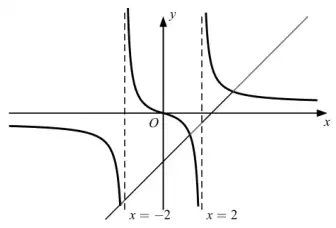 So e.g. “\(-\sqrt{5} \lt x \lt -2\)” or “\(\dfrac{5 - \sqrt{5}}{2} \lt x \lt 2\)” or “\(x \gt \dfrac{5 + \sqrt{5}}{2}\)” | M1 | 3.1a |
| Inequality holds when \(-\sqrt{5} \lt x \lt -2\) or \(\dfrac{5 - \sqrt{5}}{2} \lt x \lt 2\) or \(x \gt \dfrac{5 + \sqrt{5}}{2}\) Accept equivalent notation, e.g \(\left(-\sqrt{5}, -2\right) \cup \left(\dfrac{5 - \sqrt{5}}{2}, 2\right) \cup \left(\dfrac{5 + \sqrt{5}}{2}, \infty\right)\) | A1ft A1 | 2.2a 2.5 |
| (8) | ||
| (8 marks) |
Notes
M1: Considers the two cases of \(x \lt 0\) and \(x \geqslant 0\) to find critical values. Don’t be concerned which side the \(x = 0\) case is considered part of. Allow if “=” used when considering C.V.s. This mark is for the overall strategy, so both cases must be considered, or equivalent complete longer methods.
M1: Correct method for intersection of line and curve for \(x\) positive.
A1: Line and curve intersect at \(x = \dfrac{5 \pm \sqrt{5}}{2}\)
M1: Correct method for intersection of line and curve for \(x\) negative.
A1: Line and curve intersect at \(x = -\sqrt{5}\) Must have rejected the positive value for this mark (though may be done later)
M1: Uses the graph (or other method) to identify at least one correct region, which must include consideration of the vertical asymptotes. Implied by two correct intervals being given for their critical values. Allow if \(y = 2x - 5\) is added to the sketch and at least two (not necessarily correct) intervals produced as long as the points \(x = \pm 2\) are excluded.
A1ft: At least one correct interval identified following through their solutions (as long as it is sensible).
A1: Fully correct solution, all three intervals given – accept alternative notations, may be just listed (no need for unions shown).
Multiplying both sides by \((x - 2)^2\) or \((|x| - 2)^2\) can score a maximum of M0 M1 A1 M0 A1 M1 A1ft A0
M0 M1: for multiplying through by \((x - 2)^2\)
\((2x - 5)(x - 2)^2 \gt x(x - 2)\)
\((x - 2)\left[(2x - 5)(x - 2) - x\right] \gt 0\) leading to a value for \(x\)
\((x - 2)\left(x^2 - 5x + 5\right) \gt 0\)
A1: Line and curve intersect at \(x = \dfrac{5 \pm \sqrt{5}}{2}\)
M0A0: Not finding the point of intersection for negative \(x\)
M1 A1ft: for either “\(x \gt \dfrac{5 + \sqrt{5}}{2}\)” or “\(\dfrac{5 - \sqrt{5}}{2} \lt x \lt 2\)”
A0:
If they multiply through by \((-x - 2)^2\) the other marks can be scored