
A2 June 2022 Q7
7.
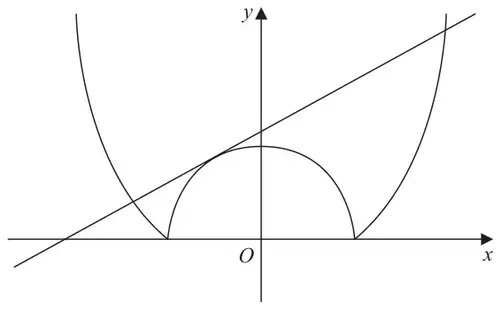
Figure 1 shows a sketch of the curve with equation \(y = \left|x^2 - 8\right|\) and a sketch of the straight line with equation \(y = mx + c\), where \(m\) and \(c\) are positive constants.
The equation
\[\left|x^2 - 8\right| = mx + c\]has exactly 3 roots, as shown in Figure 1.
Given that \(c = 3m\)
| Scheme | Marks | AO |
|---|---|---|
| Considers \(x^2 - 8 = -(mx + c) \Rightarrow x^2 + mx - 8 + c = 0\) and sets the discriminant \(= 0\) \(\left\{m^2 - 4(-8 + c) = 0\right\}\) | M1 | 3.1a |
| \(m^2 - 4c + 32 = 0\ *\) | A1* | 2.1 |
| (2) |
Notes
If both case are attempted mark for the correct one.
M1: Considers \(x^2 - 8 = -(mx + c)\) collects terms, finds the discriminant and sets \(= 0\). Must see a correct equation (without modulus) initially, though allow if subsequent slips rearranging occur.
A1*: Correct result with no incorrect working seen.
| Scheme | Marks | AO |
|---|---|---|
| \(c = 3m \Rightarrow m^2 - 4[3m] + 32 = 0 \Rightarrow m = \ldots\ (4, 8)\) or \(\Rightarrow \left(\dfrac{c}{3}\right)^2 - 4c + 32 = 0 \Rightarrow c = \ldots\ (12, 24)\) | M1 | 3.1a |
| \(m = \text{“}4\text{”} \Rightarrow c = \ldots\) or \(c = \text{“}12\text{”} \Rightarrow m = \ldots\) | M1 | 1.1b |
| Deduces that \(m = 4\) and \(c = 12\) and no other values for \(m\) and \(c\) | A1 | 2.2a |
| (3) |
Notes
M1: Substitutes \(c = 3m\) into the equation (or their equation as long as it came from an attempt at using the correct equation in (a)) and solves the resulting 3TQ to find a value for \(m\) or \(c\).
M1: Finds the corresponding value of \(c\) (or \(m\)) or solved the other 3TQ to get values for \(c\) (or \(m\))
A1: Deduces the correct values for \(m\) and \(c\). If two sets of values are stated this mark is not achieved until the extra set \(m = 8\) and \(c = 24\) are rejected (correct reason for rejection is not needed).
| Scheme | Marks | AO |
|---|---|---|
| Solves \(x^2 - 8 = \text{‘}m\text{’}x + \text{‘}c\text{’}\) and \(x^2 - 8 = -(\text{‘}m\text{’}x + \text{‘}c\text{’})\) \(x^2 - 8 = 4x + 12\) and \(x^2 - 8 = -(4x + 12)\) | M1 | 2.1 |
| \(x = 2 \pm \sqrt{24}\) o.e. and \(x = -2\) (follow through \(m = 8, c = 24 \Rightarrow x = 4 \pm 4\sqrt{3}, x = -4\)) | A1ft | 1.1b |
| \(x \leqslant 2 - 2\sqrt{6},\ x \geqslant 2 + 2\sqrt{6},\ x = -2\) (oe notation) | A1 | 2.2a |
| (3) | ||
| (8 marks) |
Notes
M1: Correct method to find all the critical values (so solves both equations). Allow if both cases are included and more than three critical values are found. Allow if relevant work was seen in (b).
A1ft: Correct three critical values only. May be implied by their final answer. Follow through on \(m = 8\) and \(c = 24\) only. Allow if the \(-2\) was seen in (b).
A1cao: Deduces the correct region. Accept any correct notation. Accept with “and” or “or”, but not with \(\wedge\)