
AS June 2025 Q4
4.
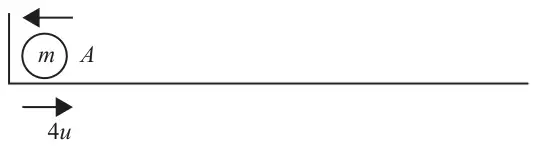
A particle \(A\) of mass \(m\) is moving on a smooth horizontal plane when it collides directly with a fixed vertical wall which is perpendicular to the direction of motion of \(A\). Immediately after the collision, the speed of \(A\) is \(4u\), directly away from the wall, as shown in Figure 1.
The coefficient of restitution between \(A\) and the wall is \(e\).
Given that the magnitude of the impulse exerted on \(A\) by the wall in the collision is \(9mu\),
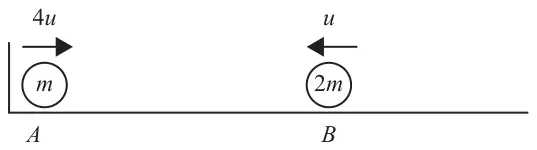
At the instant when \(A\) rebounds from the wall, a particle \(B\) of mass \(2m\) is projected along the plane towards \(A\), as shown in Figure 2.
The particles are moving in opposite directions along the same straight line when they collide directly.
Immediately before the collision, the speed of A is \(4u\) and the speed of \(B\) is \(u\).
Immediately after the collision, the total kinetic energy of the two particles is \(mu^2\)
| Scheme | Marks | AO |
|---|---|---|
| Use of impulse-momentum | M1 | 3.4 |
| \(9mu = m(4u - (-v))\) OR \(9mu = m(4u - v)\) | A1 | 1.1b |
| \(e = \dfrac{4u}{v}\) oe OR \(e = \dfrac{4u}{-v}\) oe | A1 | 1.1b |
| Use of NEL | M1 | 3.4 |
| \(e = \dfrac{4}{5}\) oe | A1 | 1.1b |
| (5) |
Notes
N.B. In part (a), the first two (M1A1) marks are for use of impulse-momentum to produce an equation in (\(m\)), \(u\) and \(v\).
The second two marks (A1M1) are for use of NEL to produce an equation in \(e\), \(u\) and \(v\).
M1: Correct no. of terms, condone sign errors. Allow consistent missing \(m\)’s.
N.B. Must be using \(4u\).
A1: Correct impulse-momentum equation.
A1: Correct NEL equation. (Must be consistent with their other equation but \(v\) does not need to be substituted.
M1: Condone sign errors but M0 if ratio of speeds is inverted.
A1: cao
| Scheme | Marks | AO |
|---|---|---|
| Use of CLM | M1 | 3.1a |
| \(4mu - 2mu = mv_A + 2mv_B\) | A1 | 1.1b |
| Use of sum of kinetic energies to obtain equation. | M1 | 3.4 |
| \(mu^2 = \dfrac{1}{2}m{v_A}^2 + \dfrac{1}{2} \times 2m{v_B}^2\) | A1 | 1.1b |
| Solve for \(v_A\) (must be 0 or a multiple of \(u\)) N.B. Allow slips with signs, brackets etc but must come from a substitution method of solution of their equations to give a quadratic. Allow if they only have one solution. N.B. They may use NEL as well to find \(v_A\left[= \dfrac{2u}{3}(1-5e)\right]\) and \(v_B\left[= \dfrac{u}{3}(2+5e)\right]\) in terms of \(e\) then sub. these into the energy equation to give a quadratic in \(e\), then find \(e\) (\(= \dfrac{1}{5}\) or \(-\dfrac{1}{5}\), which is rejected) which is then used to find \(v_A\). | DM1 | 1.1b |
| \(v_A = 0\) or \(\dfrac{4}{3}u\) Need both unless they’ve used NEL and rejected \(\dfrac{4}{3}u\) as it comes from \(e = -\dfrac{1}{5}\). N.B. \(\dfrac{4}{3}u\) is impossible but candidates do not need to show that it is impossible, since it would imply no further collision of \(A\) with the wall. | A1 | 1.1b |
| No further collision of \(A\) with the wall, with a correct justification in both cases if they have the two possible values for \(v_A\). | A1 | 2.4 |
| (7) | ||
| (12 marks) |
Notes
M1: Correct no. of terms, condone sign errors.
Allow consistent missing \(m\)’s.
Treat an incorrect mass as an A error.
A1: Correct unsimplified equation. The \(4mu\) and \(2mu\) terms must have opposite signs but the signs on the other terms could be + or \(-\).
M1: Correct no. of terms. Must be ADDING the kinetic energies.
Allow consistent missing \(m\)’s.
Treat an incorrect mass as an A error.
A1: Correct unsimplified equation, \(v_A\) and \(v_B\) do not need to be substituted.
DM1: Solve for speed of \(A\), dependent on previous two M marks.
A1: cao
A1: cso