
AS June 2024 Q3
3.
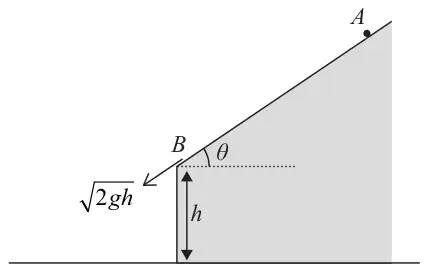
Figure 1 shows part of the end elevation of a building which sits on horizontal ground. The side of the building is vertical and has height \(h\).
A small stone of mass \(m\) is at rest on the roof of the building at the point \(A\). The stone slides from rest down a line of greatest slope of the roof and reaches the edge \(B\) of the roof with speed \(\sqrt{2gh}\)
The stone then moves under gravity before hitting the ground with speed \(W\).
In a model of the motion of the stone from \(\boldsymbol{B}\) to the ground
- the stone is modelled as a particle
- air resistance is ignored
Using the principle of conservation of mechanical energy and the model,
In a model of the motion of the stone from \(\boldsymbol{A}\) to \(\boldsymbol{B}\)
- the stone is modelled as a particle of mass \(m\)
- air resistance is ignored
- the roof of the building is modelled as a rough plane inclined to the horizontal at an angle \(\theta\), where \(\tan\theta = \dfrac{3}{4}\)
- the coefficient of friction between the stone and the roof is \(\dfrac{1}{3}\)
- \(AB = d\)
Using this model,
| Scheme | Marks | AO |
|---|---|---|
| Use the principle of conservation of mechanical energy and model | M1 | 3.4 |
| \(\dfrac{1}{2}mW^2 - \dfrac{1}{2}m\left(\sqrt{2gh}\right)^2 = mgh\) | A1 A1 | 1.1b 1.1b |
| \(W = \sqrt{4gh} = 2\sqrt{gh}\) | A1 | 1.1b |
| (4) |
Notes
M1: Correct number of terms, dimensionally correct, condone sign errors
M0 if they use \(v^2 = u^2 + 2as\)
A1: Correct equation with at most one error
A1: Correct equation
A1: Either (need \(W =\) )
| Scheme | Marks | AO |
|---|---|---|
| \(R = mg\cos\theta\) | M1 | 3.3 |
| \(F = \dfrac{1}{3}R\) | M1 | 3.4 |
| \(F = \dfrac{4}{15}mg\) | A1 | 1.1b |
| (3) |
Notes
M1: Condone sin/cos confusion and allow \(\cos\left(\tfrac{4}{5}\right)\) etc
M1: \(F = \dfrac{1}{3}R\)
A1: Accept \(0.27mg\) or better
| Scheme | Marks | AO |
|---|---|---|
| Use the work-energy principle and the model: | M1 | 3.4 |
| \(A\) to \(B\): \(mgd\sin\theta - \dfrac{1}{2}m\left(\sqrt{2gh}\right)^2 = \dfrac{4}{15}mgd\) or \(mg(h + d\sin\theta) - mgh - \dfrac{1}{2}m\left(\sqrt{2gh}\right)^2 = \dfrac{4}{15}mgd\) OR \(A\) to the ground: \(mg(h + d\sin\theta) - \dfrac{1}{2}m\left(\sqrt{4gh}\right)^2 = \dfrac{4}{15}mgd\) | A1ft A1ft | 1.1b 1.1b |
| Solve for \(d\) in terms of \(h\) or \(h\) in terms of \(d\) | M1 | 1.1b |
| \(d = 3h\) | A1 | 1.1b |
| (5) | ||
| (12 marks) |
Notes
M1: Correct number of terms, dimensionally correct, condone sign errors and sin/cos confusion and allow \(\cos\left(\tfrac{4}{5}\right)\) etc
A1ft: Correct equation with at most one error
A1ft: Correct equation ft on their answer to (b) (and (a) if they use \(A\) to the ground.)
M1: Solve for \(d\), must have at least 3 terms, with two of them in \(d\)
A1: cao
N.B. No marks available if they don’t use work-energy