
A2 June 2025 Q4
4.
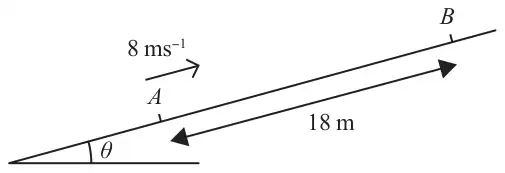
A rough straight ramp is fixed to horizontal ground. The ramp is inclined at an angle \(\theta\) to the horizontal, where \(\sin\theta = \dfrac{1}{14}\). The points \(A\) and \(B\) are on a line of greatest slope of the ramp with \(AB = 18\) m and \(B\) above \(A\), as shown in Figure 1.
A package of mass 0.5 kg is projected up the ramp from \(A\) with speed \(8\ \text{m s}^{-1}\) and comes to instantaneous rest at \(B\).
The work done against friction as the package moves from \(A\) to \(B\) is \(W\) joules.
The package is modelled as a particle and air resistance is ignored.
The coefficient of friction between the package and the ramp is \(\mu\)
| Scheme | Marks | AO |
|---|---|---|
| Work-energy equation: | M1 | 3.4 |
| \(\dfrac{1}{2} \times 0.5 \times 8^2 = W + 0.5g \times 18\sin\theta\) | A1 | 1.1b |
| \(W = 16 - 9g \times \dfrac{1}{14} = 9.7\) * | A1* | 2.2a |
| (3) |
Notes
M1: Form work-energy equation in terms of \(W\) (and \(g\) and \(\theta\)) only. All required terms present and no extras. All terms dimensionally correct (of correct structure). Condone \(\pm\) sign errors on terms and sin/cos confusion on vertical height. M0 if a term is missing or for incorrect trig use eg \(18\tan\theta,\ \dfrac{18}{\sin\theta},\ \dfrac{18}{\cos\theta}\). M0 for use of suvat
A1: Correct unsimplified equation, no need to replace trig.
A1*: Obtain given answer from complete and correct working. Must see a line of working between the initial equation and the given answer. Condone missing \(W\) during working but must see ‘\(W = \ldots\)’ for the final mark.
| Scheme | Marks | AO |
|---|---|---|
| Use of \(F = \mu R = \mu \times 0.5g\cos\theta\) | M1 | 3.1b |
Complete method to form a dimensionally correct equation in \(\mu\) (and \(\theta\)) using
| M1 | 3.4 |
| A1 | 1.1b |
| \(\mu = 0.11 \quad (0.110)\) | A1 | 1.1b |
| (4) | ||
| (7 marks) |
Notes
M1: Correct use of \(F = \mu R\) and \(R = 0.5g\cos\theta\) to form an expression for Friction. Dimensionally correct. Condone sin/cos confusion. Missing \(g\) is an accuracy error not a method error.
M1: Complete method to form a dimensionally correct equation in \(\mu\) (\(\theta\) and \(g\)). Trig does not need to be replaced for M mark. M0 for \(W = \mu R\).
May use 9.7 and work done \(= F \times 18\) to form a dimensionally correct equation in \(\mu\).
May see relevant suvat to find acceleration, followed by N2L to form dimensionally correct equation \(\mu\). N2L must contain all relevant terms and no extras. Condone sin/cos confusion on the weight components.
A1: Correct unsimplified equation in \(\mu\) (and \(g\)) with trig replaced correctly.
A1: 2 sf or 3 sf only. A0 for use of \(g = 9.81\ \text{m s}^{-2}\)
(Corrected from the printed mark scheme: the N2L equation in the second method is printed as \(-\mu \times 0.5g\cos\theta \times 18 - 0.5g\sin\theta = 0.5\left(-\dfrac{16}{9}\right)\); the friction force has no factor of 18 in an equation of motion.)