
AS June 2025 Q4
4.
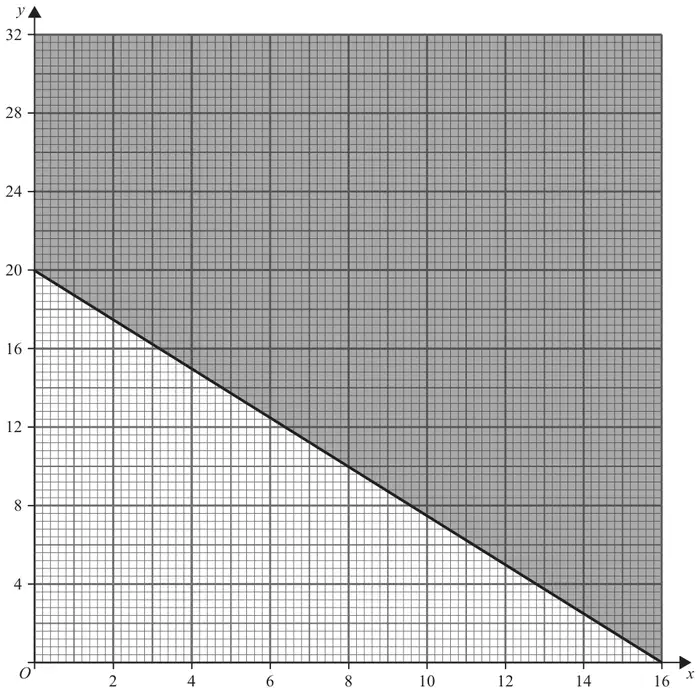
George is a baker who bakes \(x\) sponge cakes and \(y\) fruit cakes every day.
One of George’s constraints is shown on Figure 3.
Three further constraints are
- George must bake at least four fruit cakes every day
- for every two sponge cakes George bakes, he must bake at most three fruit cakes
- George needs 200 g of butter for each sponge cake and 100 g for each fruit cake and has 2.8 kg of butter available each day
[Diagram 1 in the answer book is a copy of Figure 3.]
George makes £8 profit from each sponge cake he sells and £5 profit from each fruit cake he sells. Given that he wishes to maximise his profit,
| Scheme | Marks | AO |
|---|---|---|
| \(5x + 4y \leqslant 80\) | B1 | 2.5 |
| (1) |
Notes
a1B1: CAO Must be the correct inequality.
| Scheme | Marks | AO |
|---|---|---|
| (i) \(y \geqslant 4\) \(2x + y \leqslant 28\) | B1 | 3.3 |
| \(3x \geqslant 2y\) | M1 A1 | 3.3 2.2a |
(ii)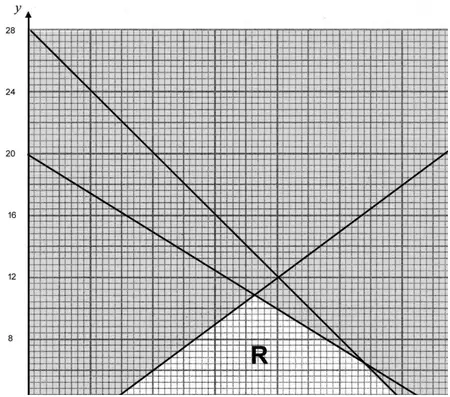 | B1 B1 | 1.1b 2.2a |
| (5) |
Notes
bi1B1: \(y \geqslant 4\) and \(2x + y \leqslant 28\) (oe) both correct.
bi1M1: \(3x \,\square\, 2y\) where \(\square\) is any inequality sign or =, or \(2x \geqslant 3y\)
bi1A1: \(3x \geqslant 2y\) correct
bii1B1: Any two lines correctly drawn. (Use the following to help you judge; send to review any that are worthy of credit).
For \(y = 4\) within one small square of (2,4) and (12,4)
For \(2x + y = 28\) within one small square of at least two of (0,28), (8,12) (12,4) or (14,0)
For \(3x = 2y\) within one small square of (0,0) and (8,12)
bii2B1: All three lines correctly drawn (with shading) and \(R\) correctly labelled.
| Scheme | Marks | AO | ||||||||||||
|---|---|---|---|---|---|---|---|---|---|---|---|---|---|---|
| B1 B1 M1 | 1.1b 1.1b 3.4 | ||||||||||||
| Optimal vertex \(\left(10\tfrac{2}{3},\ 6\tfrac{2}{3}\right)\) | A1 | 1.1b | ||||||||||||
| 11 sponge (cakes), 6 fruit (cakes) | B1 | 3.2a | ||||||||||||
| (5) | ||||||||||||||
| (11 marks) |
Notes
c1B1: Two of the three non-optimal vertices correct or one correct with corresponding P value correct (P values should be exact or rounded to 2dp). Accept correct top-heavy fractions for coordinates and P values.
c2B1: Two non-optimal vertices correct with corresponding P values correct.
c1M1: Attempt to solve simultaneous equations for vertex (10 2/3, 6 2/3). May be implied by correct optimal vertex
c1A1: Correct optimal vertex and corresponding P value.
c3B1: CAO with context. If candidate has the incorrect feasible region (e.g following \(2x = 3y\)) award this mark even if the integer solution is outside their feasible region.
SC: Alt. Method – Candidate only considers integer solutions
(3,4) P = 44
(8,10) P = 114
(12,4) P = 116
Optimal: (11,6) P = 118
B1 Two non-optimal vertices correct with P value
B1 Three non-optimal vertices correct with P value
M1A1 correct optimal vertex and P value
B1 CAO with context