
AS June 2024 Q4
4.
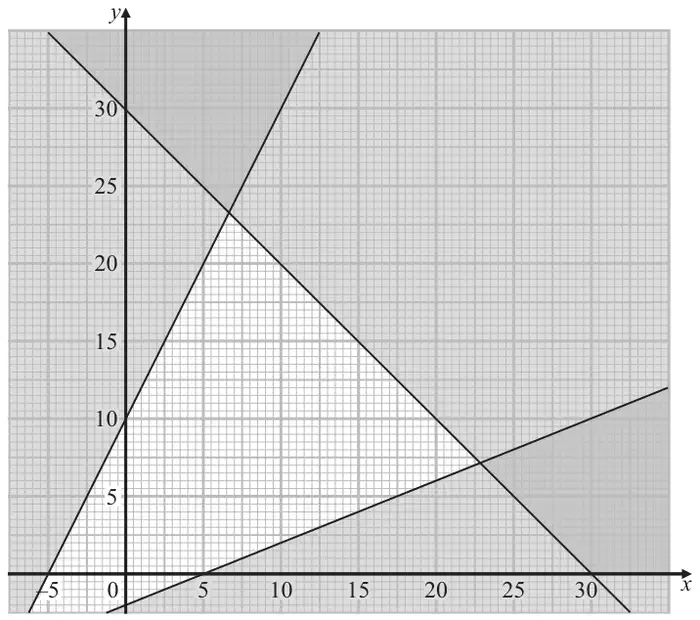
Figure 4 shows three of the six constraints for a linear programming problem in \(x\) and \(y\)
The unshaded region and its boundaries satisfy these three constraints.
The variables \(x\) and \(y\) represent the number of orange fish and the number of blue fish, respectively, that are to be kept in an aquarium.
The number of fish in the aquarium is subject to these three further constraints
- there must be at least one blue fish
- the orange fish must not outnumber the blue fish by more than ten
- there must be no more than five blue fish for every orange fish
[Diagram 1 in the answer book is a copy of Figure 4.]
The total value (in pounds) of the fish in the aquarium is given by the objective function
\[\text{Maximise } P = 3x + 5y\]| Scheme | Marks | AO |
|---|---|---|
| \(x + y \leqslant 30\) \(y \leqslant 2x + 10\) \(5y \geqslant 2x - 10\) | M1 A1 A1 | 3.3 1.1b 2.5 |
| (3) |
Notes
M1: One correct inequality in any form e.g. \(y - 2x - 10 \leqslant 0\). Condone strict inequality. Must be simplified to three terms only but coefficients do not need to be integers.
A1: Two correct inequalities in any form e.g. \(y - 2x - 10 \leqslant 0\). Condone strict inequalities. Must be simplified to three terms only but coefficients do not need to be integers.
A1: All three inequalities correct with three terms and integer coefficients. Must not be strict inequalities.
SC: M1A0A0 for two correct “equations”, either with = or inequality reversed
The graph does NOT show \(x \geqslant 0\) and \(y \geqslant 0\), so these will not be accepted. Ignore any reference to these.
| Scheme | Marks | AO |
|---|---|---|
| \(y \geqslant 1\) \(y + 10 \geqslant x\) \(y \leqslant 5x\) | B1 B1 | 3.3 3.3 |
| (2) |
Notes
B1: Any one of \(y \geqslant x - 10\) or \(y \leqslant 5x\) in any form (accept strict inequalities)
B1: All three correct in any form. Must not be strict inequalities.
| Scheme | Marks | AO |
|---|---|---|
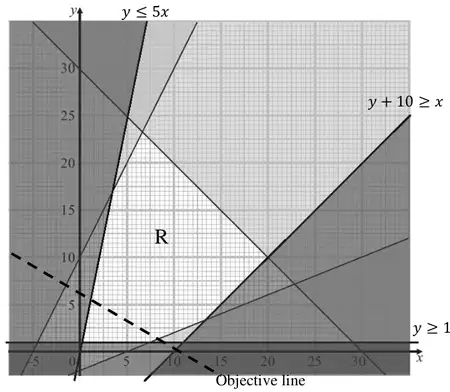 | M1 A1ft A1 | 1.1b 1.1b 1.1b |
| (3) |
Notes
M1: One line drawn with gradient 1 or gradient 5 (or 1/5). Condone dashed line.
A1ft: Either \(y \geqslant x - 10\) or \(y \leqslant 5x\) drawn correctly, with correct shading. Condone dashed line. ft their stated inequalities from part (b), but allow recovery.
A1: CAO All three correct inequalities drawn correctly with solid lines and the correct region \(R\) labelled. Penalise any poorly drawn lines (e.g. not straight).
Accuracy within 1 small square.
\(y \geqslant x - 10\) passes through (10,0) and (20,10).
\(y \leqslant 5x\) passes through (0,0) and (5,25).
| Scheme | Marks | AO |
|---|---|---|
| (i) Objective line drawn \(3x + 5y = \textit{constant}\) \(\left(\text{m} = \dfrac{-3}{5}\right)\) | M1 | 2.1 |
| Optimal point \(\left(\dfrac{20}{3},\ \dfrac{70}{3}\right)\) | A1 | 2.2a |
| (ii) Consideration of integer coordinates around the optimal vertex. | dM1 | 1.1b |
| 7 orange fish and 23 blue fish Total value \(3(7) + 5(23) =\) (£)136 | A1 | 3.2a |
| (4) | ||
| (12 marks) |
Notes
(d)(i) M1: Objective line drawn accurately. Parallel to a line passing through (0,6) and (10,0). Accuracy within 1 small square. (Minimum passing through (0,3) and (5,0)).
Accept reciprocal gradient for M mark only.
A1: Correct optimal point \(\left(\dfrac{20}{3},\ \dfrac{70}{3}\right)\) oe. Accept \(x = \dfrac{20}{3}\) and \(y = \dfrac{70}{3}\)
(d)(ii) dM1: Dependent on 1st M1 and correct objective line. Consideration of integer point(s) around the optimal vertex. Candidate must have tested at least two of (6,23), (6,24), (7,23) and (7,24).
A1: CAO Clear statement including 7 orange (fish) and 23 blue (fish) and (total value) (£)136
Integer points for consideration:
| \(x\) | \(y\) | \(x + y \leqslant 30\) | \(y \leqslant 2x + 10\) | \(3x + 5y\) |
|---|---|---|---|---|
| 6 | 23 | ✓ | ✗ | 133 |
| 6 | 24 | ✓ | ✗ | 138 |
| 7 | 23 | ✓ | ✓ | 136 |
| 7 | 24 | ✗ | ✓ | 141 |